What catch-all actually means
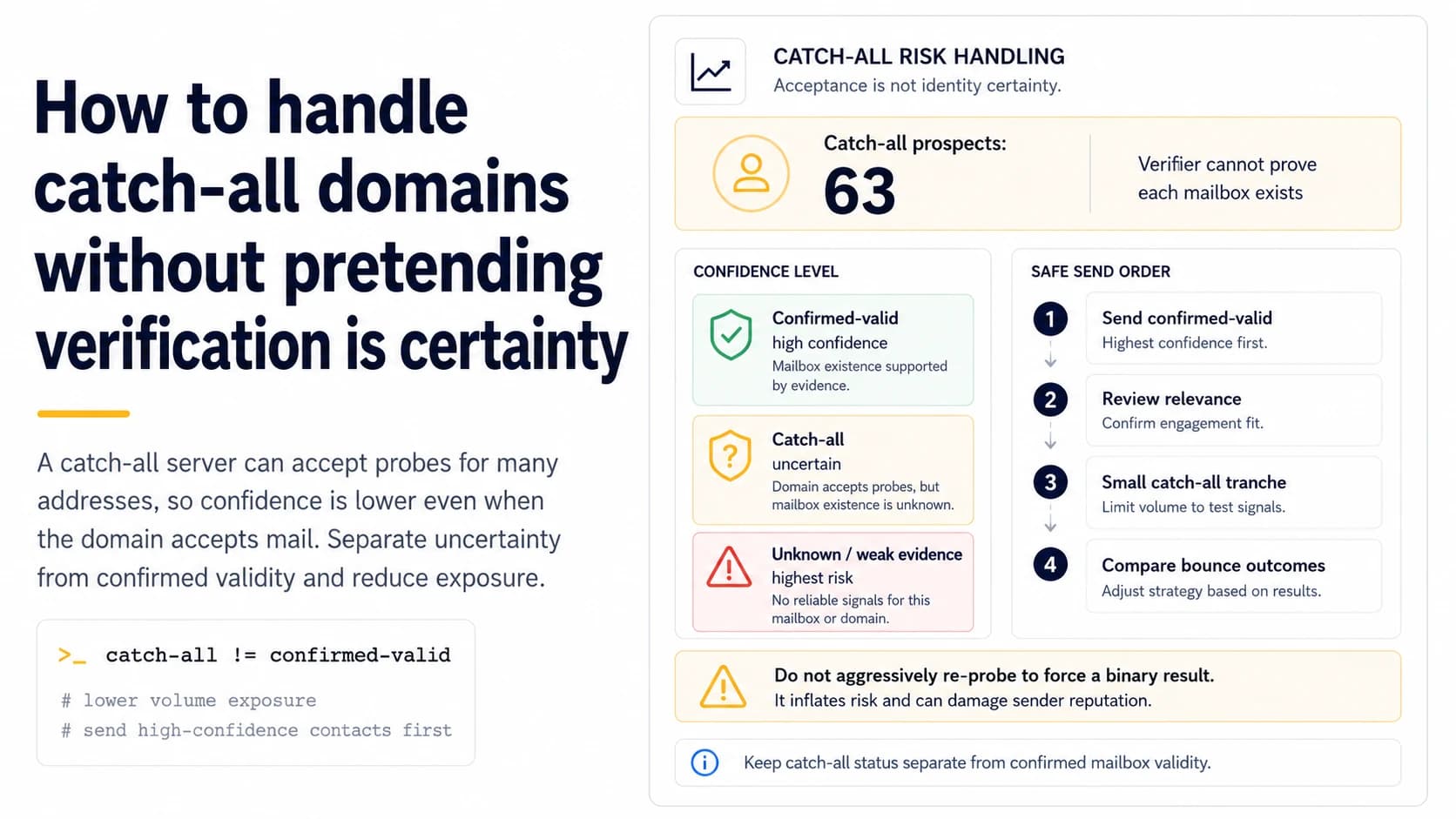
A catch-all domain is configured so the receiving system may accept mail for addresses beyond a known set of named mailboxes. That makes pre-send mailbox existence harder to prove: a server accepting `made-up-name@example.com` does not establish that `maya@example.com` belongs to a person. Verification tools therefore often label these addresses as catch-all, accept-all, or risky rather than confirmed. The important operating choice is to preserve that uncertainty instead of converting it into a reassuring green “valid” status.
Separate domain acceptance from identity confidence
The domain can be technically capable of receiving mail while the specific prospect address remains uncertain. Keep two fields if necessary: domain/mail status and mailbox-confidence status. This helps list operators avoid throwing away every catch-all domain while also preventing them from treating all 63 catch-all rows in a file as equally verified. Other evidence—recent first-party correspondence, a current company page, a reliable source, or prior successful delivery—can raise confidence without pretending SMTP probing proved identity.
Reduce blast radius for uncertain rows
If a campaign contains both strongly verified named mailboxes and catch-all addresses, send the stronger segment first and observe it. Introduce uncertain rows in smaller tranches so a bad pattern is visible before the whole group is exposed. This is especially important on a new or recently changed sending domain. A catch-all label is not itself a bounce prediction; it is a reason to control exposure because the verification step could not eliminate the mailbox-existence question.
Do not use aggressive probing as a substitute for uncertainty
Repeated SMTP probing can be unreliable and may be rate-limited or treated as abusive by receiving systems. Some providers deliberately avoid revealing recipient validity before accepting a message. A small sender should not escalate verification into a mini mail attack just to force a binary answer. When the infrastructure cannot know, keep the state as unknown or catch-all, improve data provenance, and decide whether the contact is important enough to test through normal, low-volume outreach.
Watch hard-bounce outcomes by verification state
After sending, compare permanent failure counts for confirmed, catch-all, and unknown segments. Use absolute counts when samples are small. If two of fifteen catch-all rows hard-bounce while zero of sixty confirmed rows do, that difference should affect the next campaign even if it is not a statistically perfect experiment. Suppress the failed addresses globally and consider re-checking the remaining uncertain segment. Your own outcomes are the best evidence for how a particular data source behaves.
Prioritize relevance because acceptance is not permission
A catch-all server can accept technically deliverable mail that a shared gateway or human recipient never wanted. Verification only addresses delivery risk; it does not make targeting appropriate. For uncertain addresses, require stronger relevance and personalization criteria, not weaker ones. If the contact identity itself is doubtful, sending generic copy to “see what happens” creates both data-quality and recipient-experience risk.
Use a confidence ladder instead of a pass/fail column
A practical sheet might label contacts as confirmed, prior-delivered, catch-all with strong source, catch-all with weak source, temporary-unknown, and suppressed. Route high-confidence rows into normal batches, uncertain rows into small diagnostic tranches, and suppressed rows nowhere. This ladder gives a solo operator more control than a single verifier badge and makes campaign outcomes traceable back to the evidence available at send time.
Use catch-all as a routing property, not proof of a person
A catch-all result tells you that the domain may accept mail for addresses that are not individually confirmed. It does not establish that the named employee exists, that the mailbox is monitored, or that a future message will be accepted after internal filtering. Treat the result as an uncertainty flag attached to otherwise verified company and person data. For example, a lead whose job title and company are current but whose domain is catch-all may be placed in a smaller test tranche; a lead with stale employment data and a catch-all result should be deprioritized because both identity and mailbox confidence are weak. This layered decision is more defensible than converting catch-all into either automatic rejection or automatic approval.
Measure catch-all outcomes separately after sending
Create a reporting dimension for verification state so real outcomes feed back into hygiene policy. If 100 normal verified addresses produce one permanent recipient failure while 40 catch-all addresses produce six, the difference is operationally meaningful even though the sample is small. Suppress every permanent failure immediately, inspect whether the catch-all rows came from one stale source, and tighten the next batch. Do not use a successful delivery to one catch-all contact as proof that all addresses at that domain are valid. The objective is to learn which combination of data age, source and domain behavior produces acceptable risk for your own outbound process, while keeping uncertain segments small enough that a bad assumption cannot damage the whole domain.
Keep uncertain contacts out of the first ramp batch
When a domain or mailbox is still establishing a recent sending pattern, avoid using the first production tranche to test the riskiest addresses at the same time. Start with the freshest, most deterministic contacts so any bounce or deferral signal is easier to interpret. Catch-all rows can be introduced later in a small labeled segment after the infrastructure has produced a clean baseline. This sequencing does not make catch-all addresses safe; it prevents list uncertainty from being confounded with a new-domain experiment. If the catch-all segment performs materially worse, stop there without exposing the rest of the domain to the same uncertainty.
Keep catch-all risk visible after a successful delivery
A successful first delivery to a catch-all domain should update the contact history, but it should not erase the fact that the original mailbox verification was uncertain. Preserve both pieces of evidence. The delivery raises confidence for that exact address; it does not prove that another guessed local-part at the same domain will work. If the person later replies, that is stronger evidence still. By keeping the original catch-all flag alongside subsequent delivery and reply history, the system learns at the contact level without converting one good outcome into a broad domain-wide assumption.
Field checklist
- Keep catch-all status separate from confirmed mailbox validity.
- Record the source evidence that supports each uncertain address.
- Send high-confidence contacts before catch-all tranches.
- Avoid aggressive repeated probing to force a binary result.
- Compare hard bounces by verification state and source.
- Require strong targeting relevance when address confidence is lower.
Primary sources
Standards and provider policies can change. These links are the reference points used for this field note.
- RFC 3463 — Enhanced Mail System Status CodesIETF / RFC Editor — 2.x.x, 4.x.x and 5.x.x delivery status code classes.
- Email sender guidelinesGoogle Gmail Help — Authentication, TLS, DNS, spam-rate and bulk-sender requirements.
- SMTP Error CodesYahoo Sender Hub — Yahoo guidance for temporary deferrals, permanent errors, unknown recipients and traffic-pattern problems.