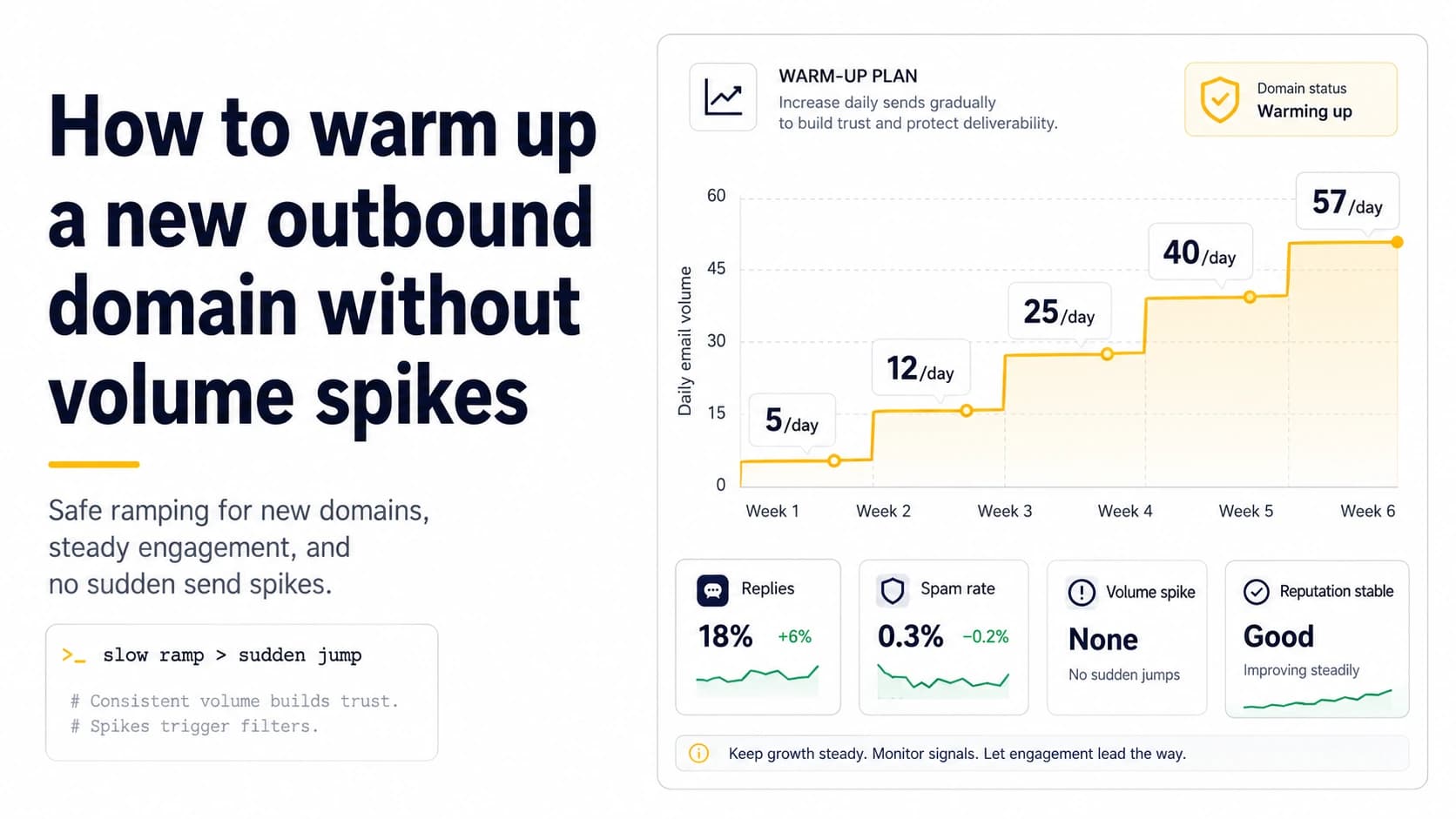
How to warm up a new outbound domain without volume spikes
A gradual ramp is less about obeying a magic schedule and more about avoiding abrupt changes while authentication, bounces and real replies stay healthy.
Read field note →Filter by the layer you are operating. Every article is scoped to one question and links back to primary technical sources.
A gradual ramp is less about obeying a magic schedule and more about avoiding abrupt changes while authentication, bounces and real replies stay healthy.
Read field note →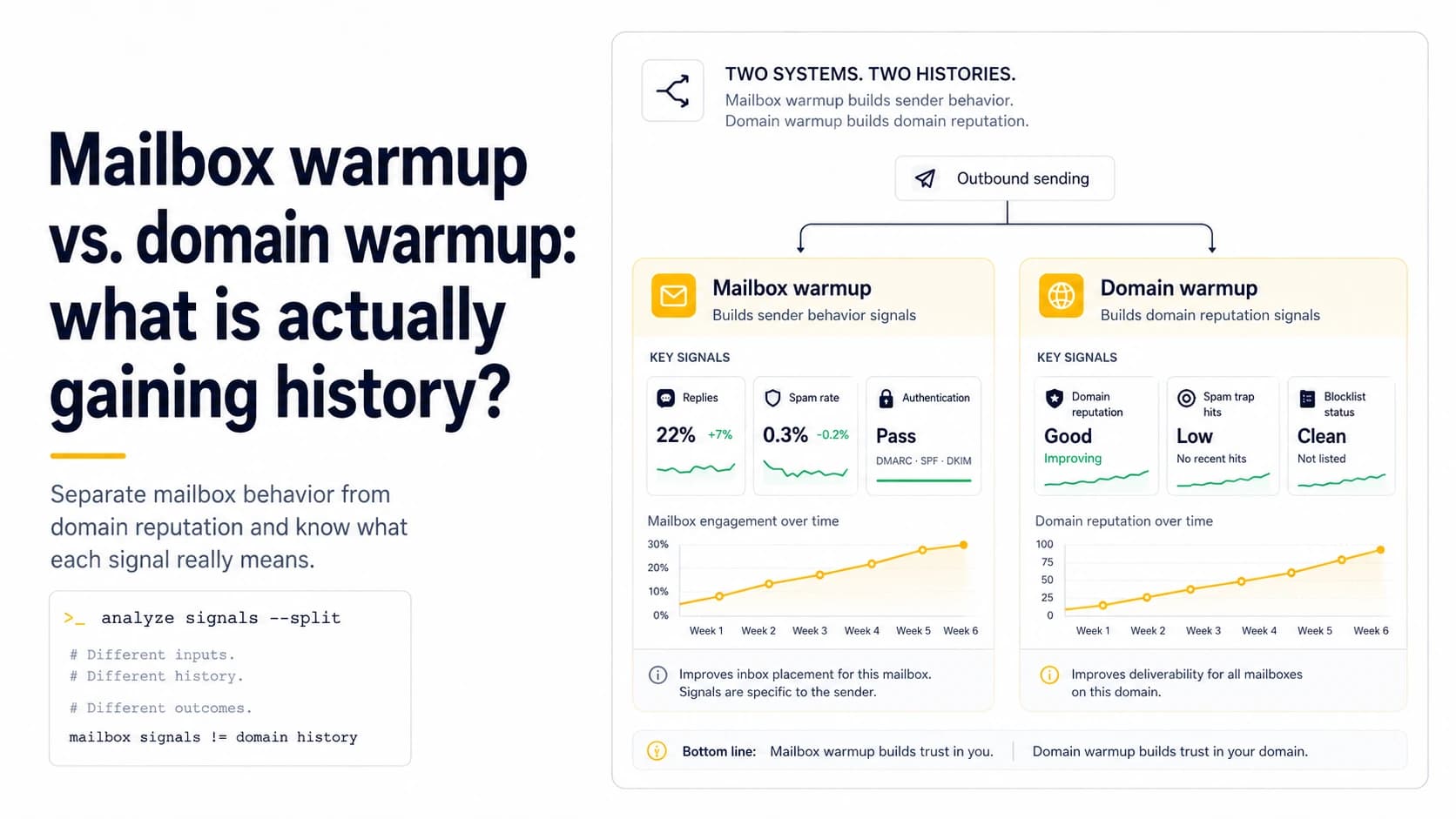
A mailbox and its parent domain share signals but are not interchangeable; adding a fresh mailbox to an established domain does not give it an identical behavioral history.
Read field note →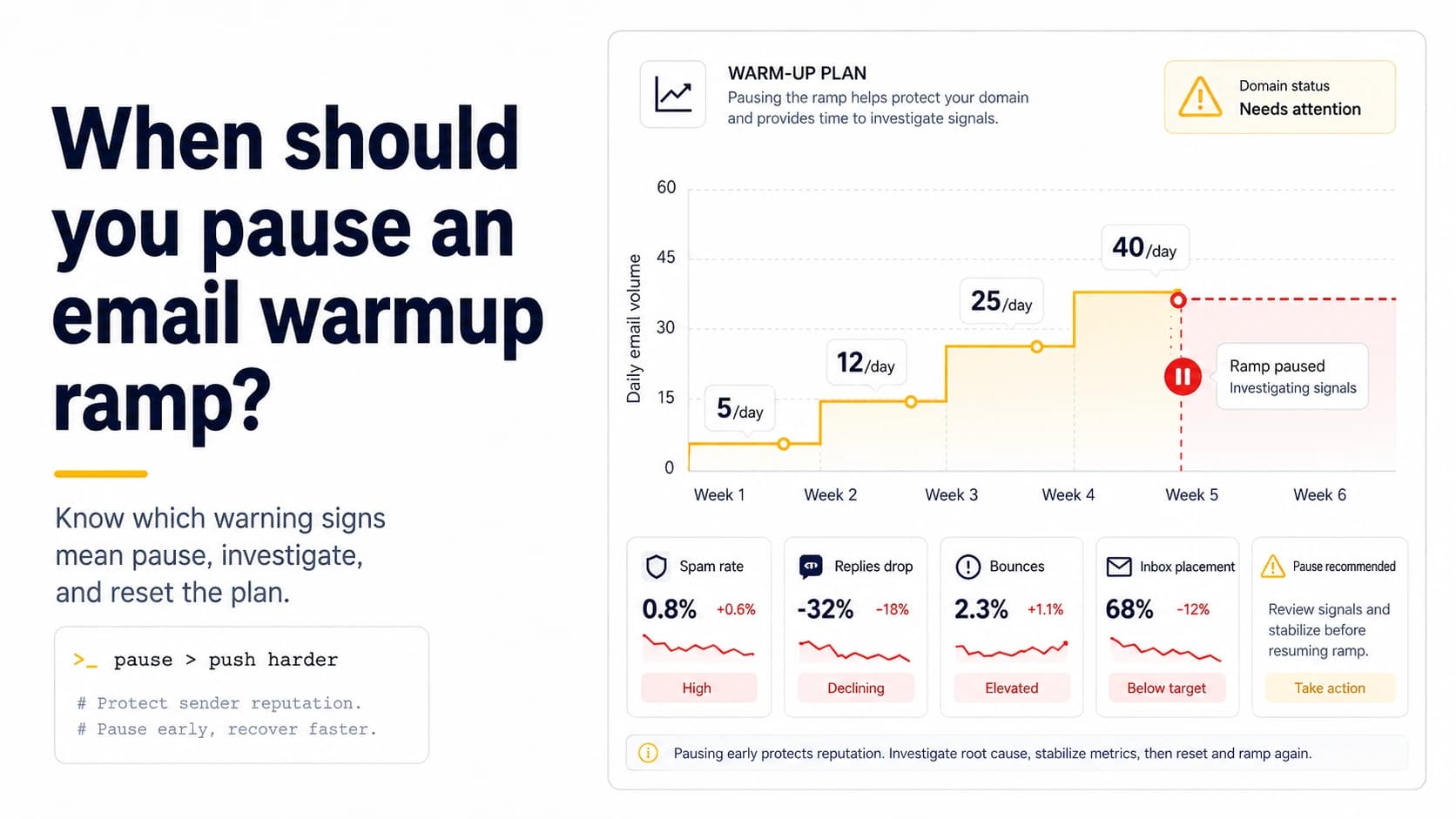
Pause when a negative signal changes materially, not merely because a fixed number of days has passed.
Read field note →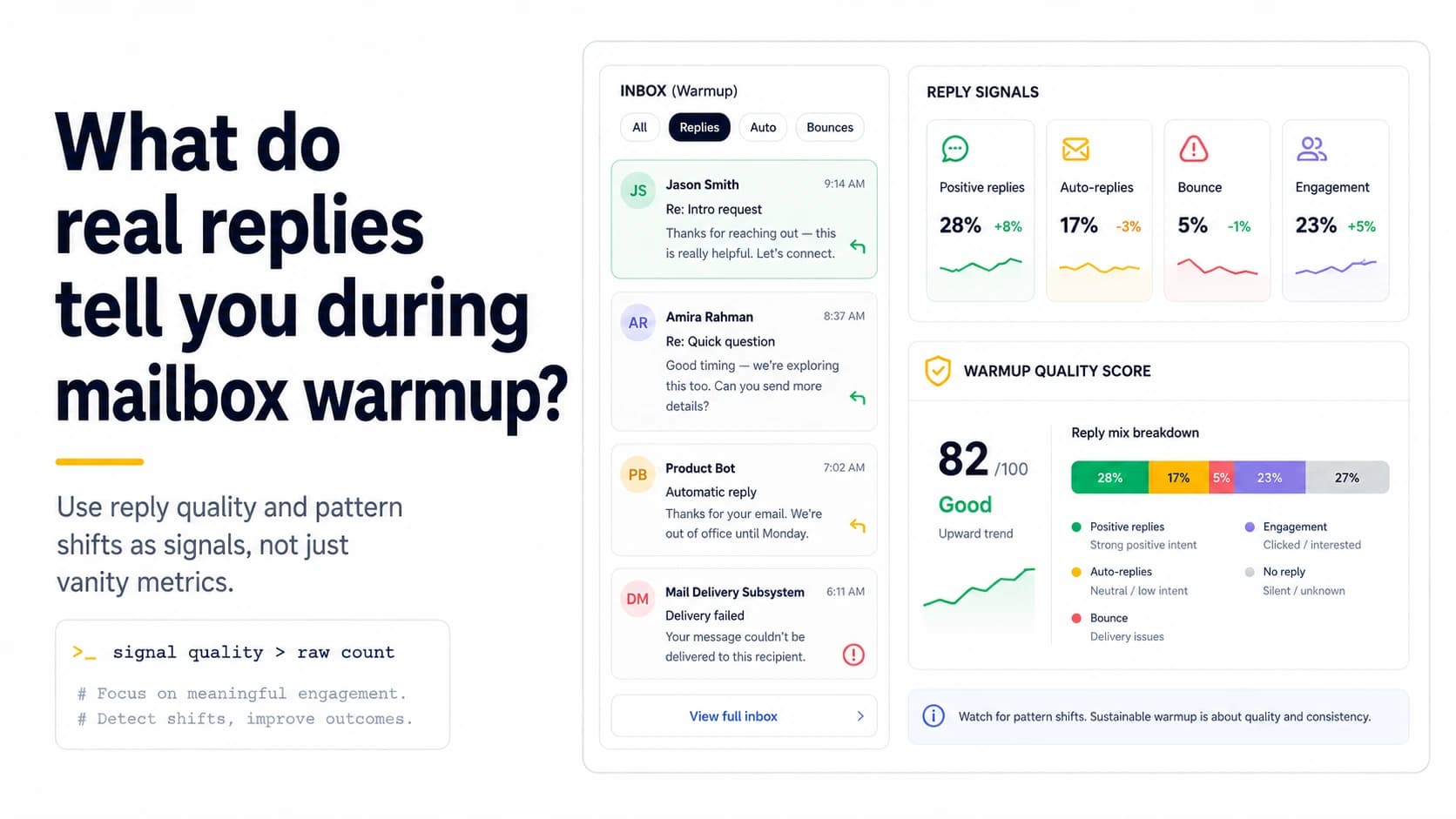
Replies are useful evidence of normal two-way use, but they are not a substitute for authentication, low bounce rates or recipient relevance.
Read field note →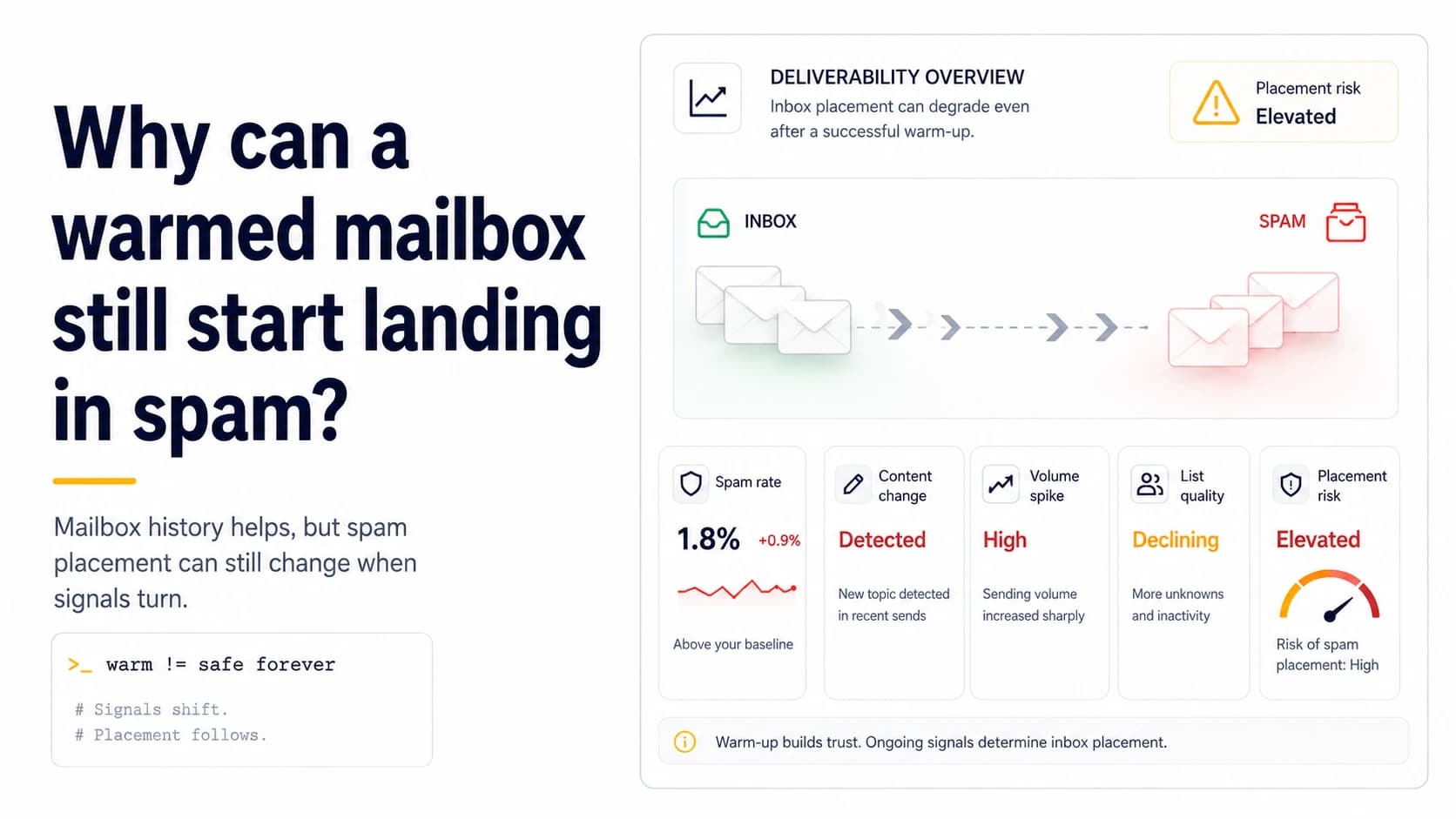
Warmup history cannot protect a sender from new authentication errors, stale lists, abrupt volume changes or complaint pressure.
Read field note →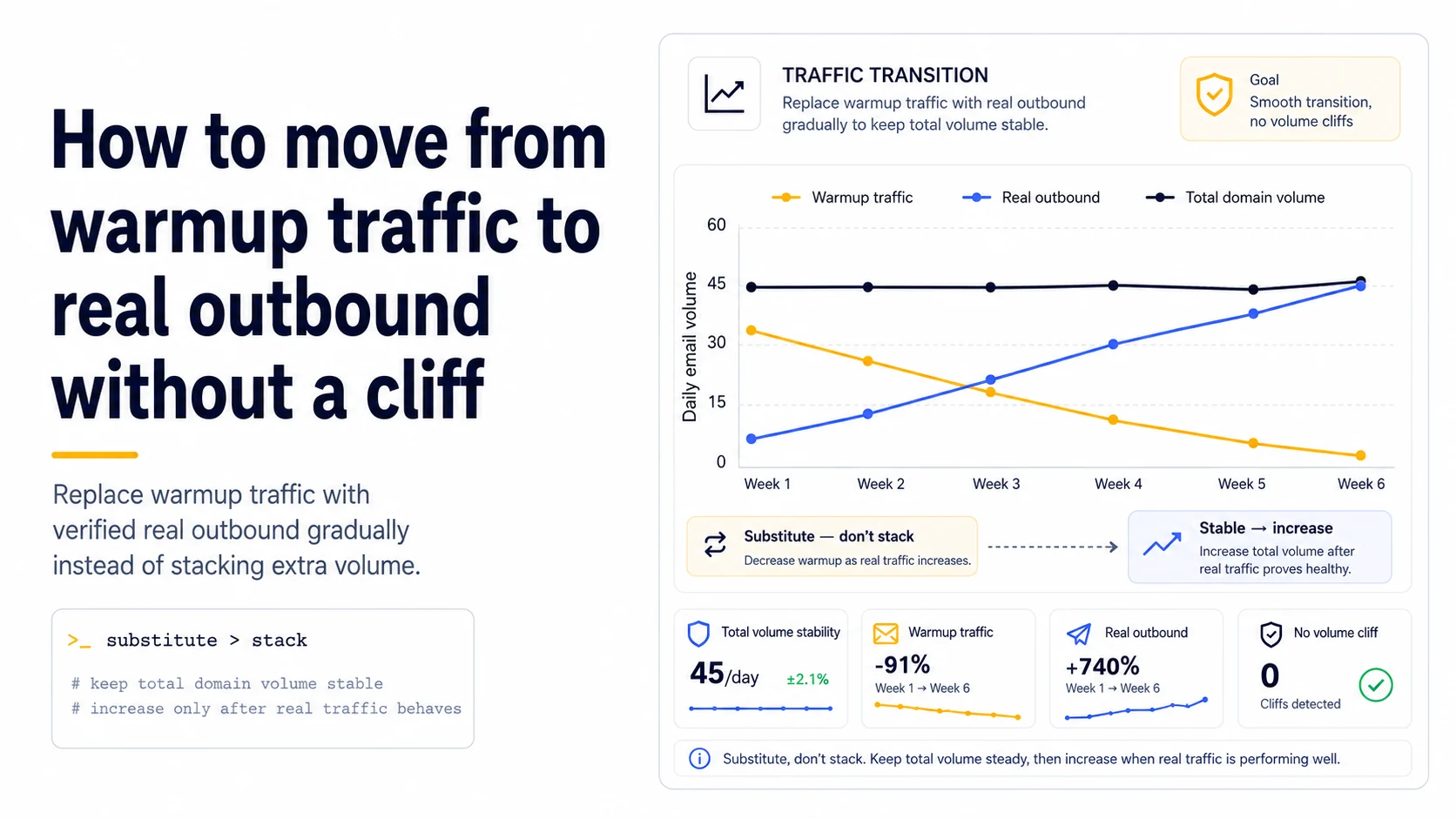
Transition by replacing synthetic or low-risk traffic with real, relevant conversations gradually instead of stacking a full prospect campaign on top.
Read field note →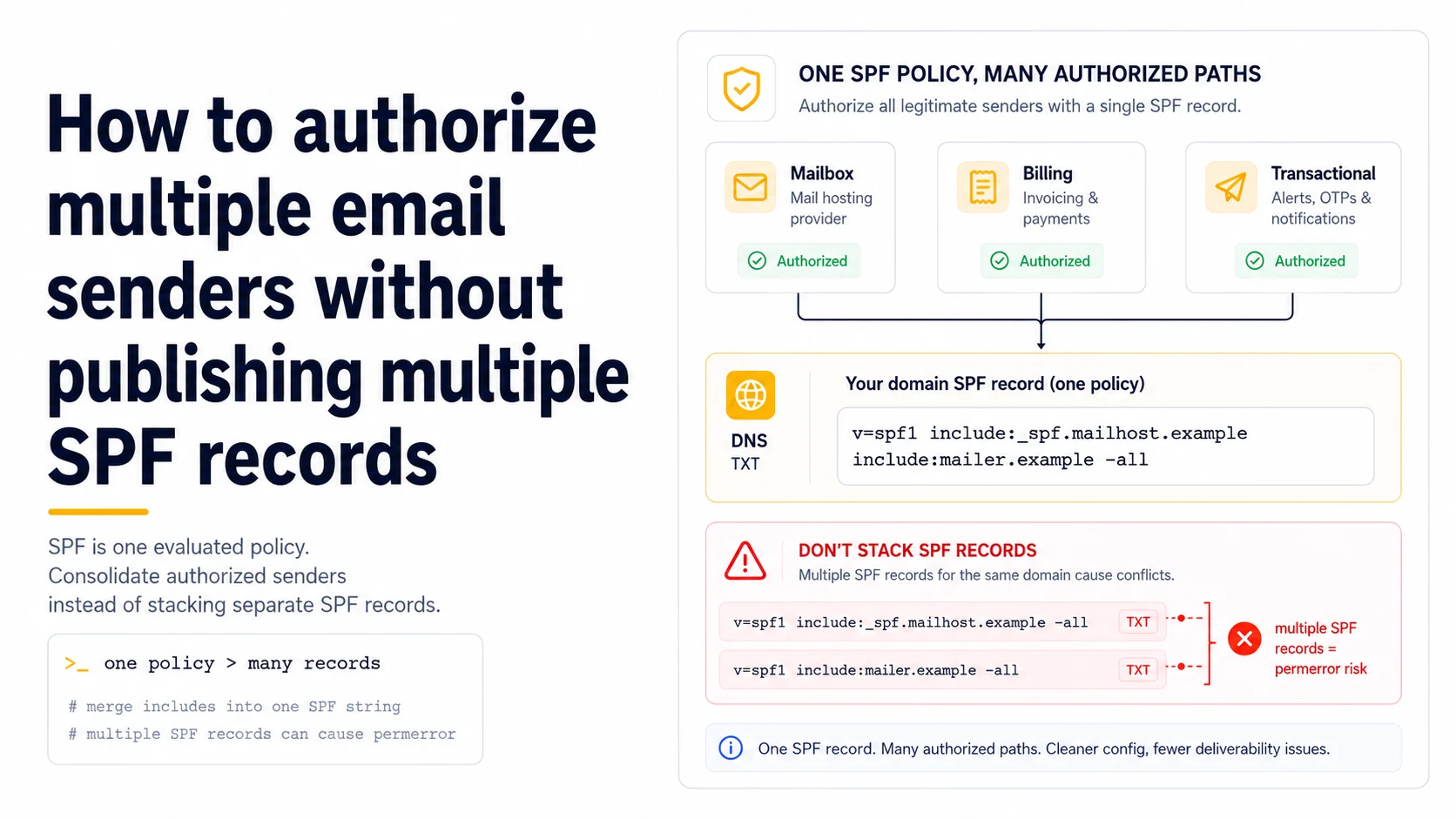
SPF is evaluated from a single policy record for a domain; multiple independent SPF TXT records can create a permanent error instead of broader authorization.
Read field note →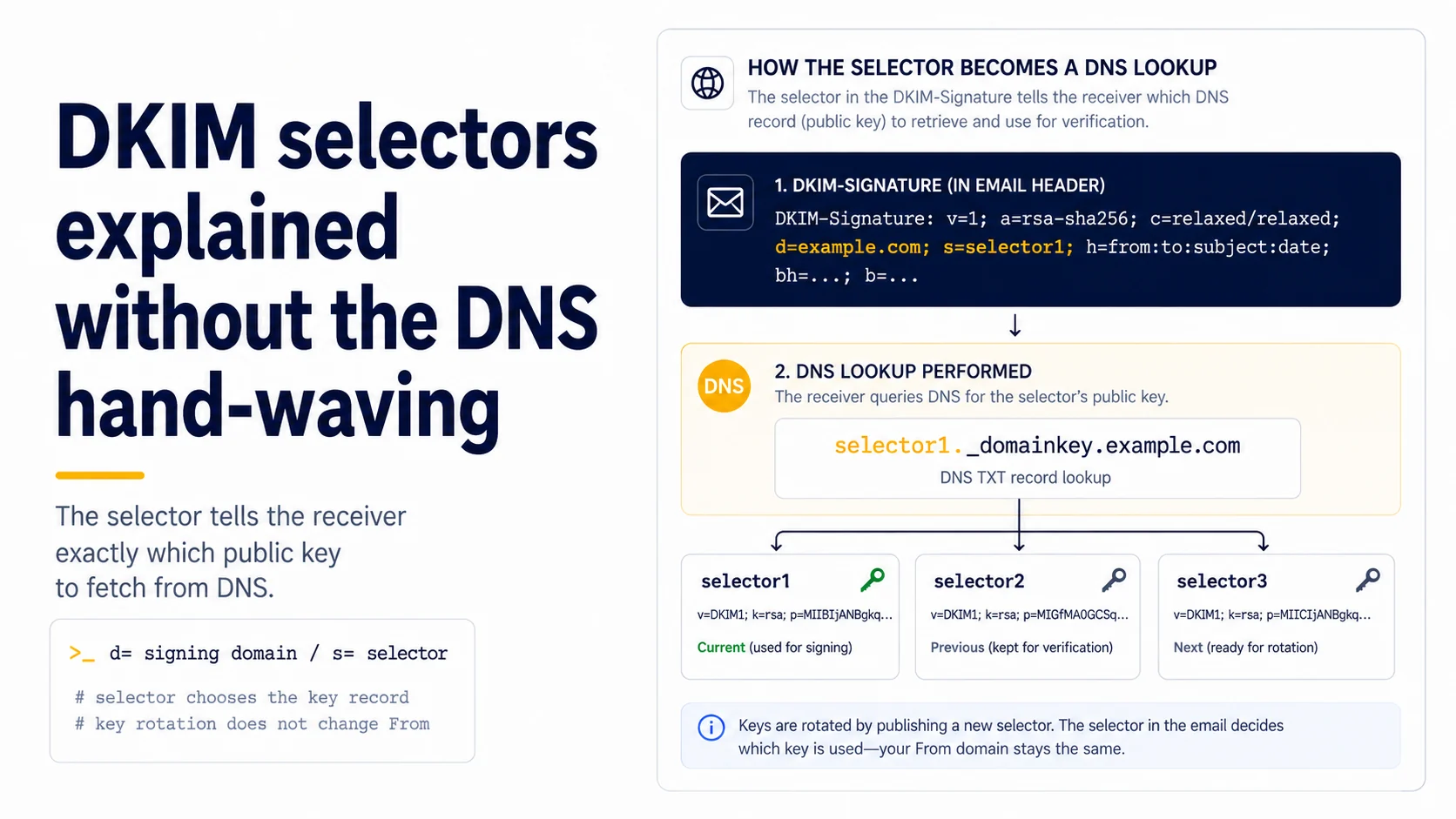
A DKIM selector tells receivers which public key record to retrieve; rotating selectors lets a sender change keys without changing the From domain.
Read field note →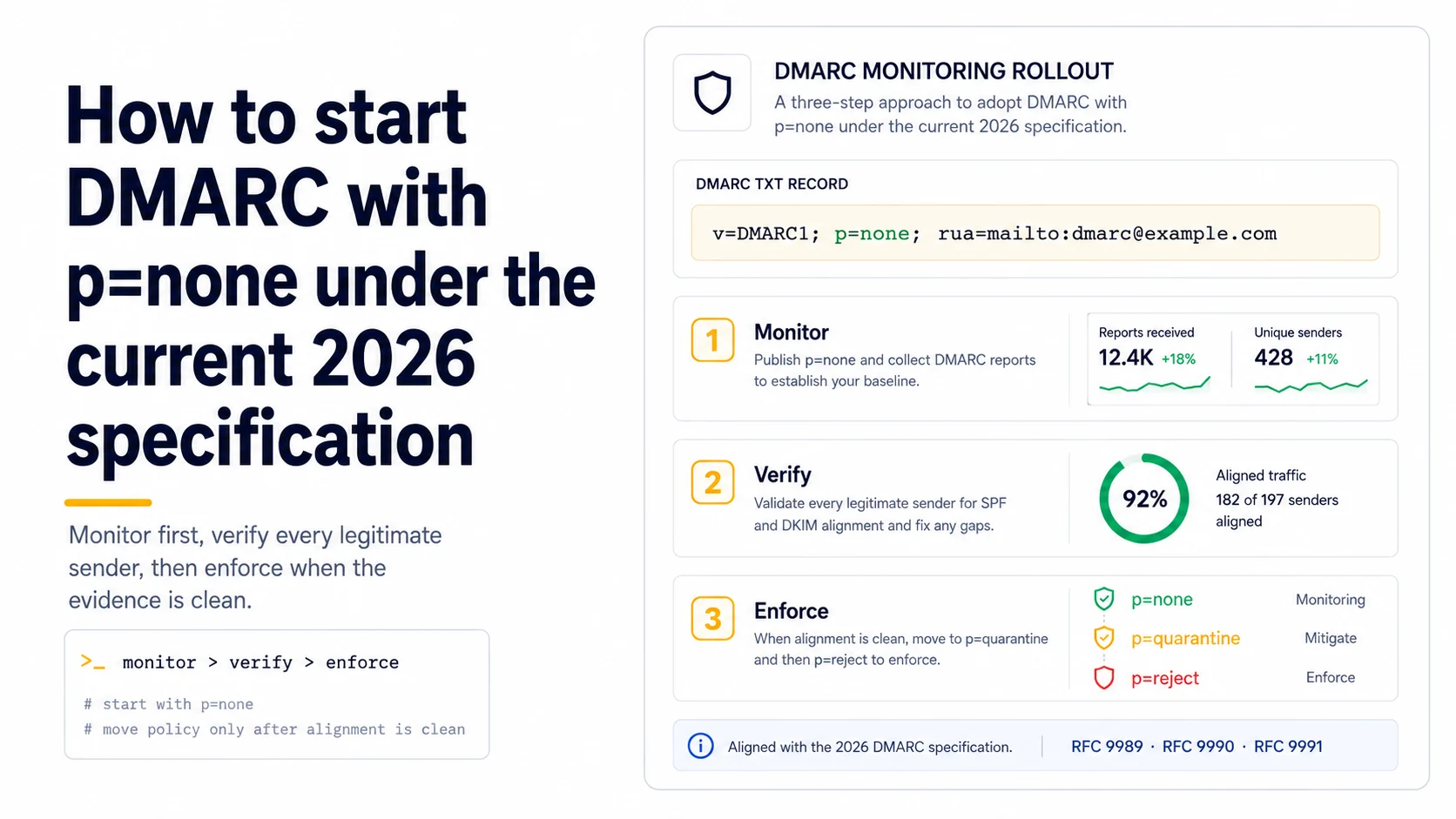
A monitoring policy lets a domain observe alignment before moving to stricter disposition; the current protocol reference is RFC 9989, with reporting split into RFC 9990 and RFC 9991.
Read field note →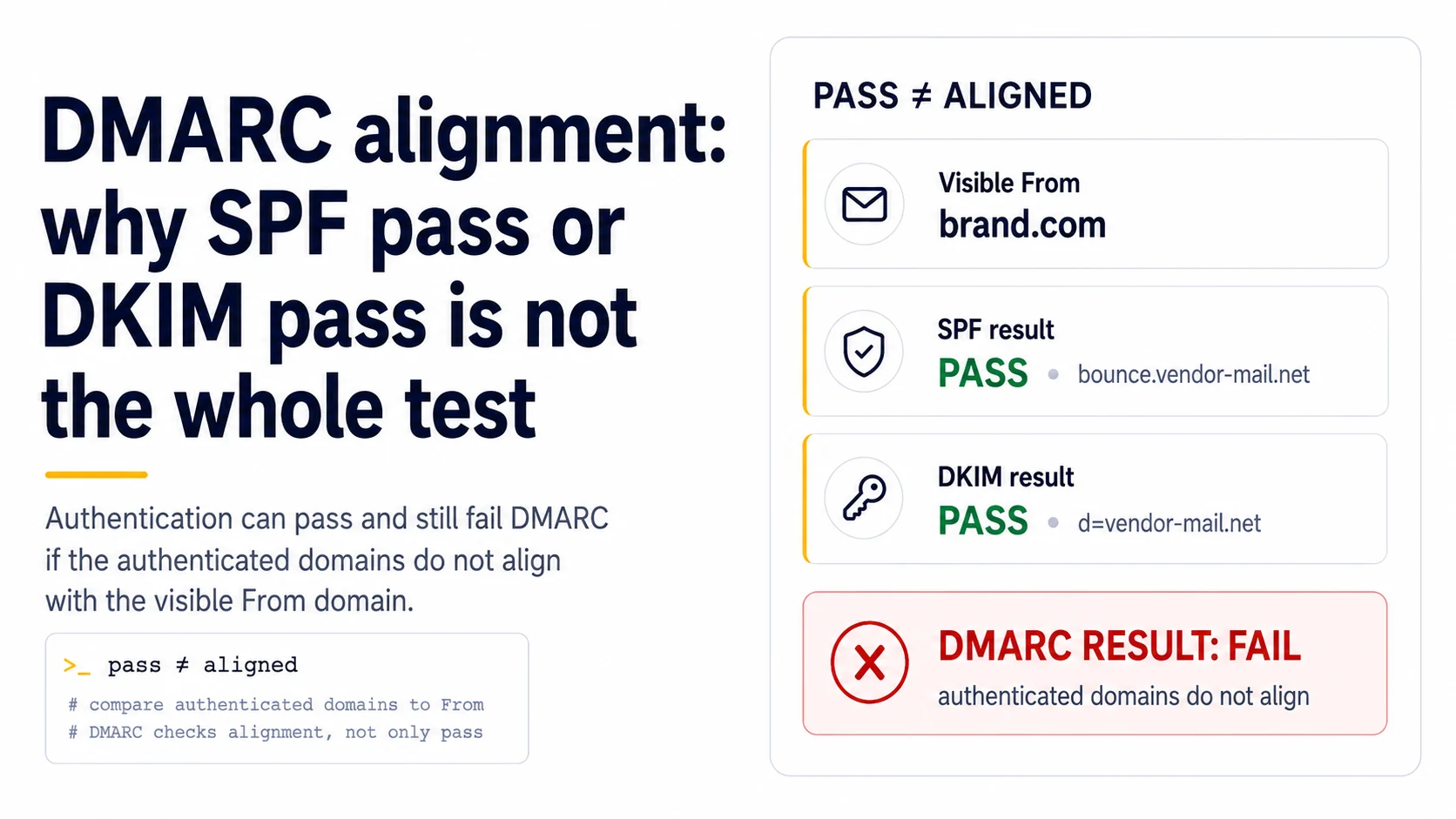
DMARC evaluates whether an authenticated SPF or DKIM domain aligns with the visible From domain, so a raw PASS can still fail the alignment requirement.
Read field note →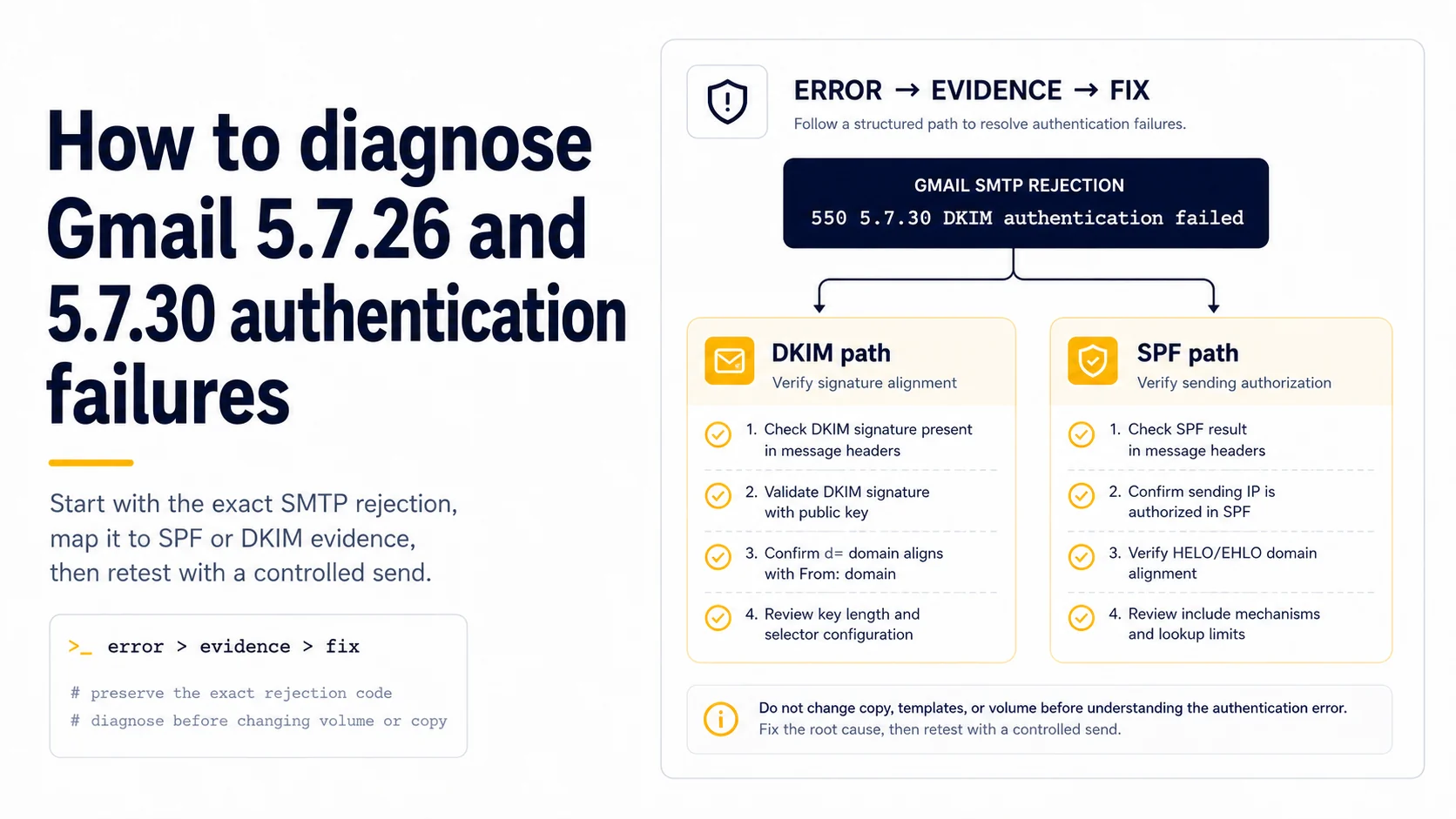
Start with the exact rejection code and Authentication-Results evidence before changing unrelated copy or sending volume.
Read field note →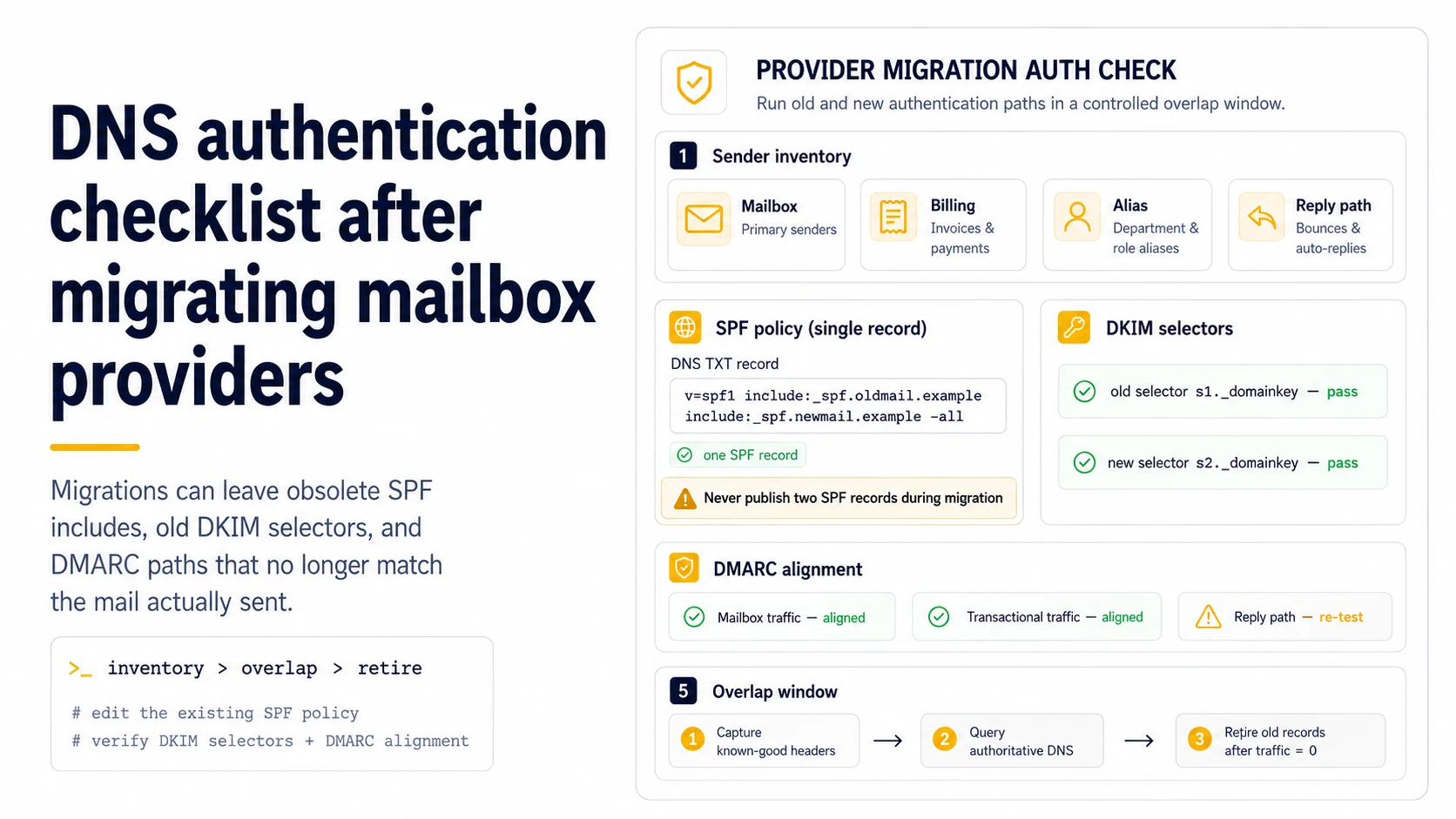
A provider migration can leave obsolete SPF includes, old DKIM selectors or alignment paths that no longer match the message actually sent.
Read field note →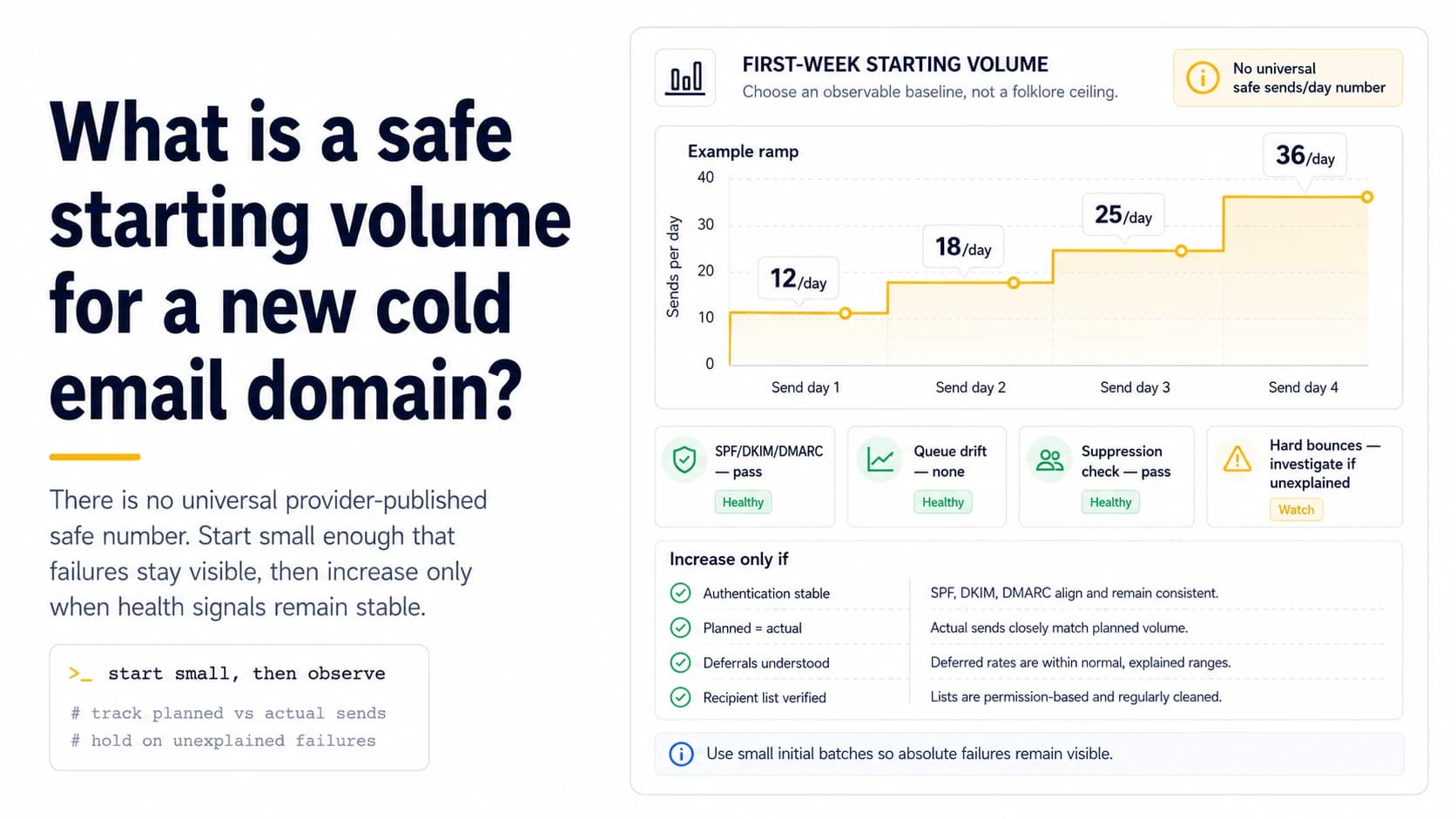
There is no provider-published universal safe number for cold outbound; start small enough that a few failures are visible and increase only after health signals stay stable.
Read field note →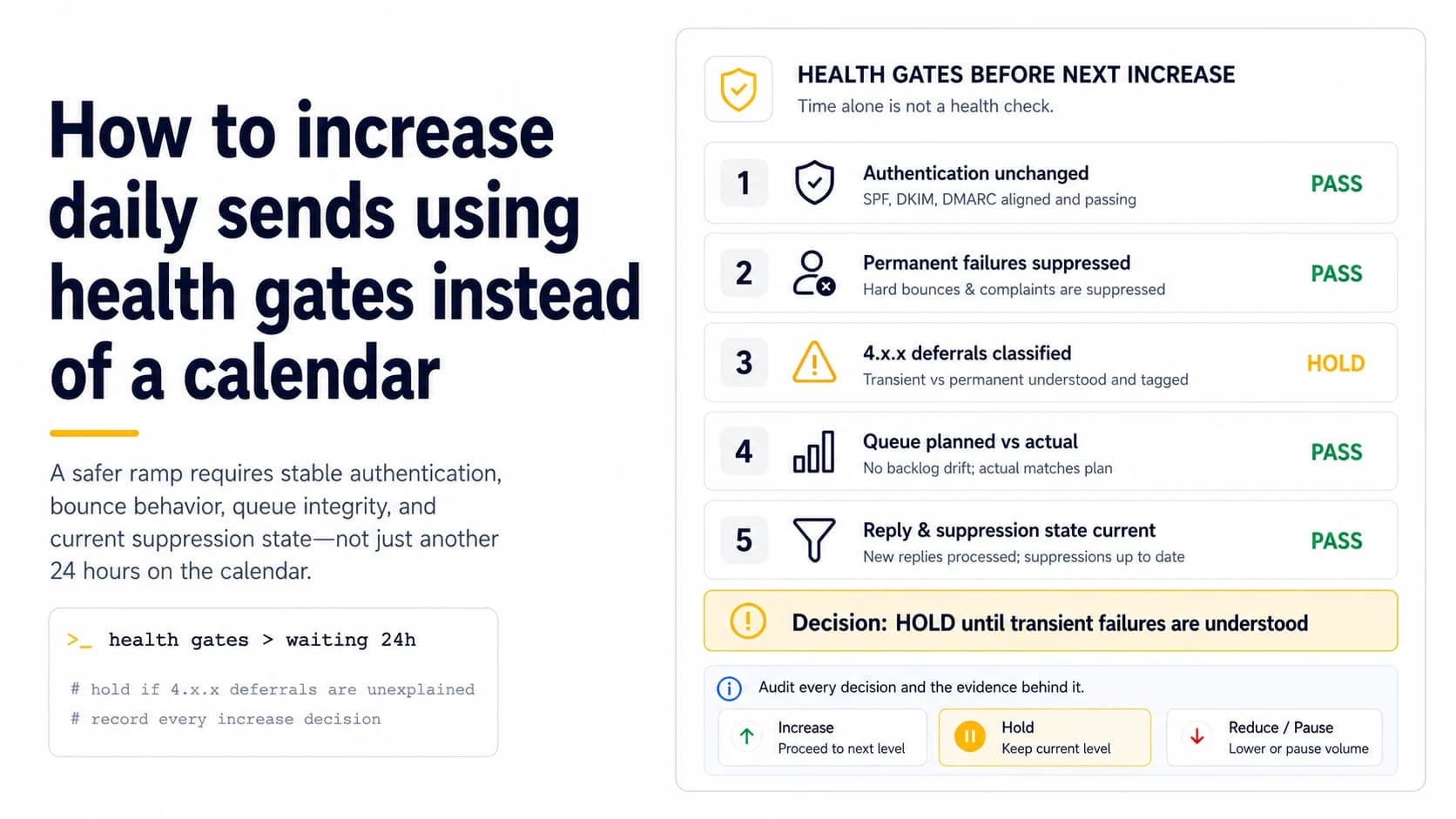
A ramp becomes safer when each increase requires stable authentication, bounce behavior and response state rather than simply waiting 24 hours.
Read field note →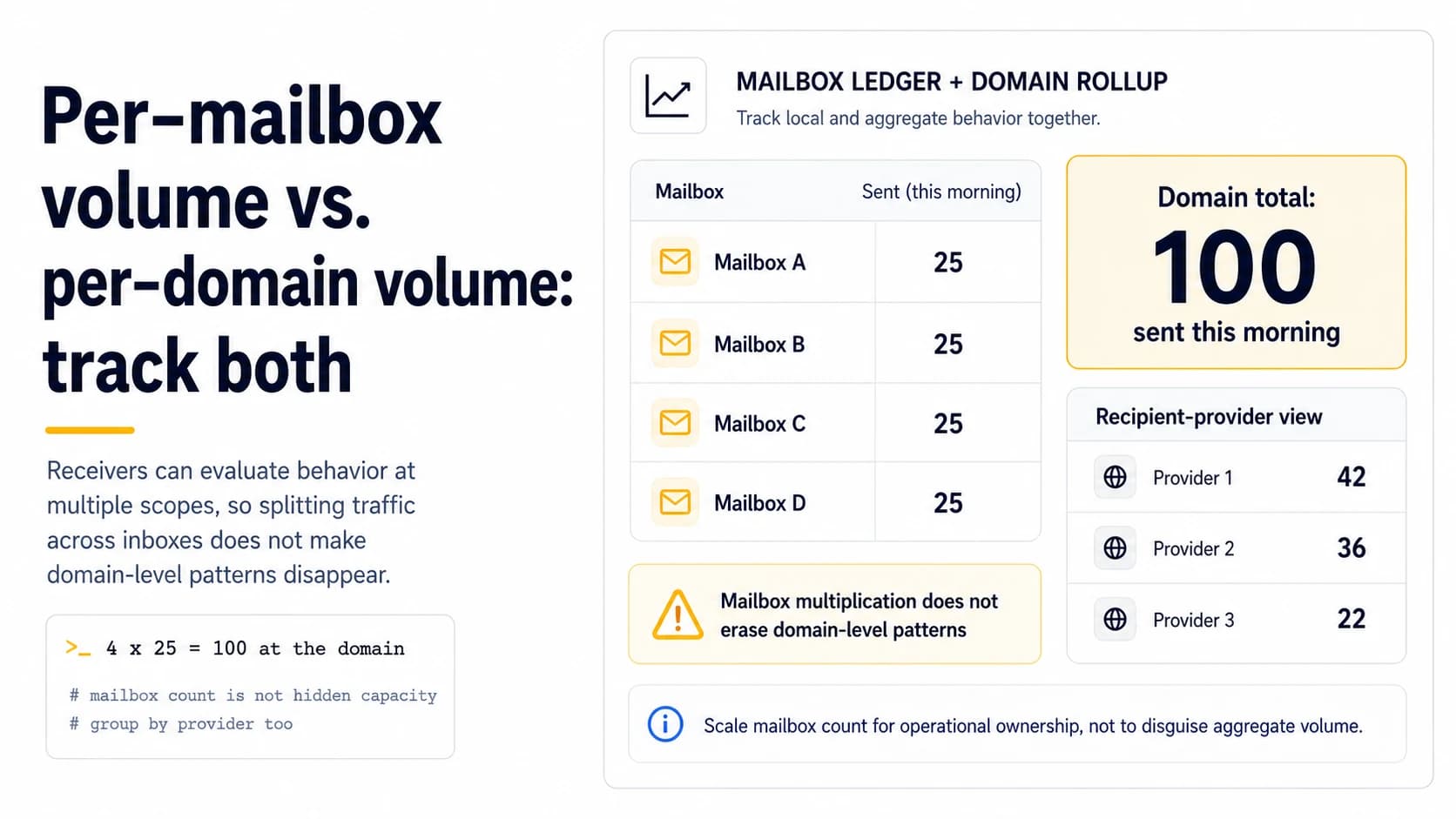
Receivers and providers can evaluate behavior at multiple scopes, so distributing traffic across mailboxes does not make domain-level patterns disappear.
Read field note →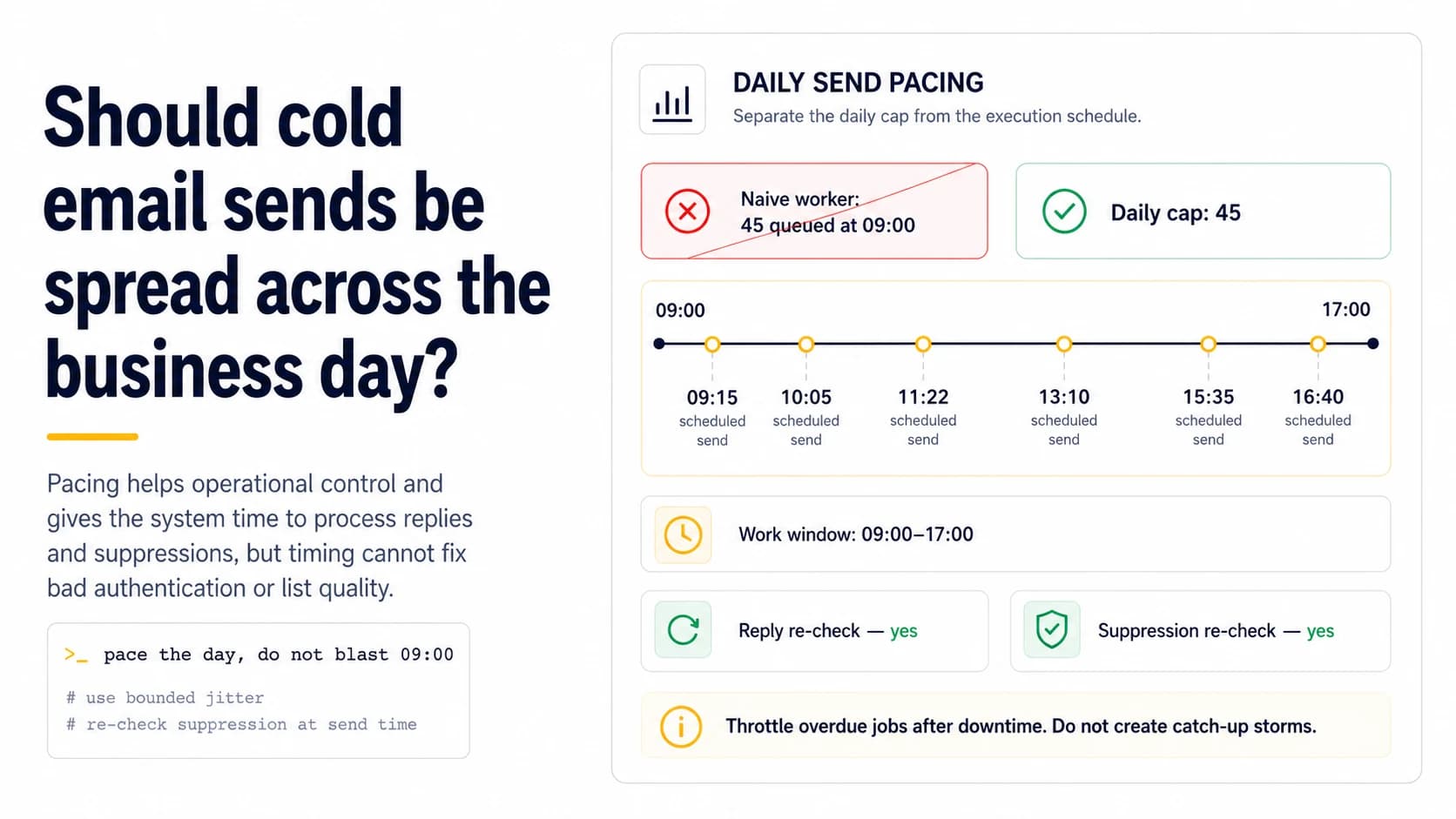
Spacing sends avoids machine-like bursts and gives the system time to process replies and suppressions before later touches, but timing cannot compensate for bad authentication or lists.
Read field note →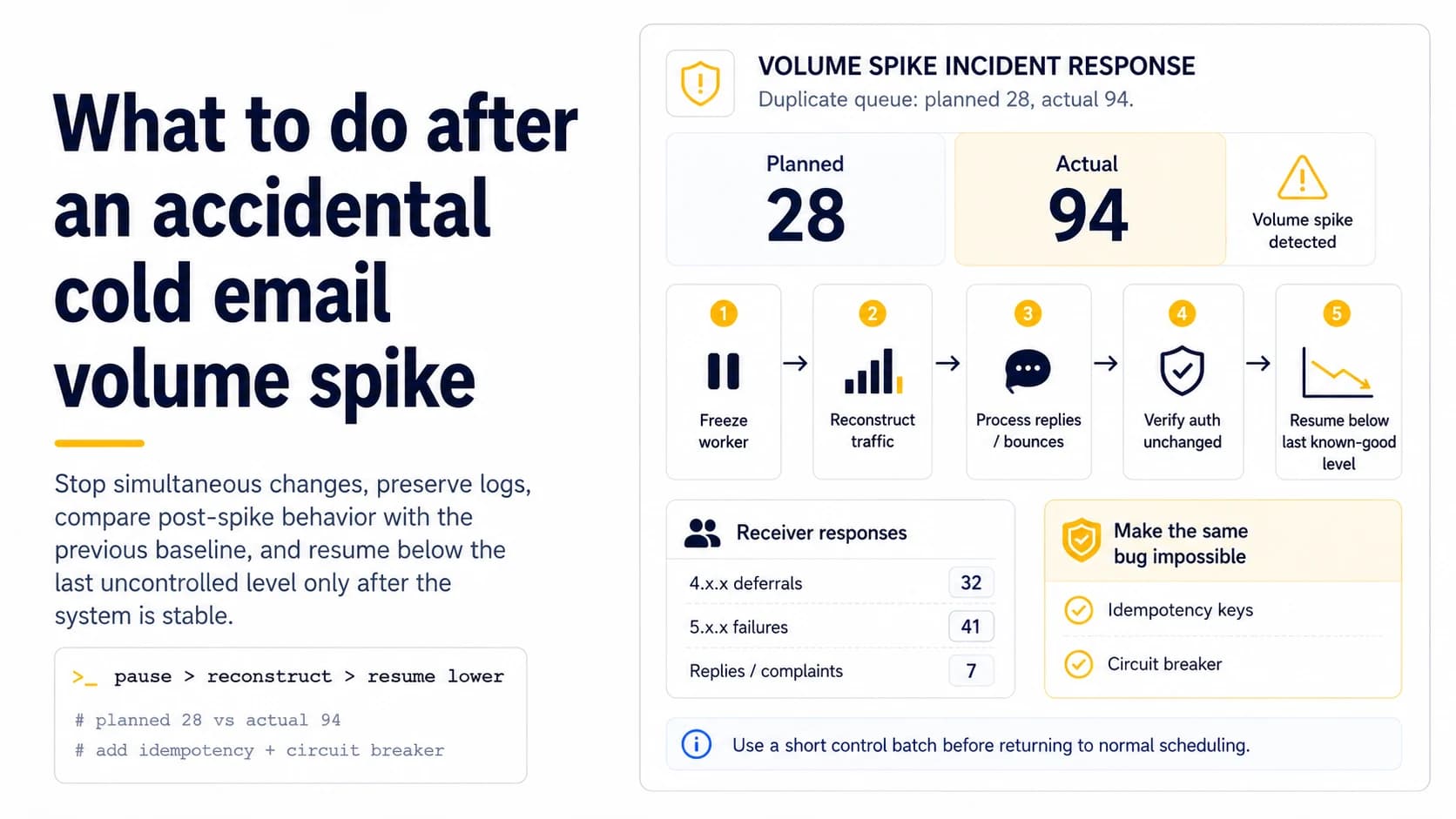
Stop making simultaneous changes, preserve logs, and compare post-spike authentication, bounce and reply behavior with the previous baseline.
Read field note →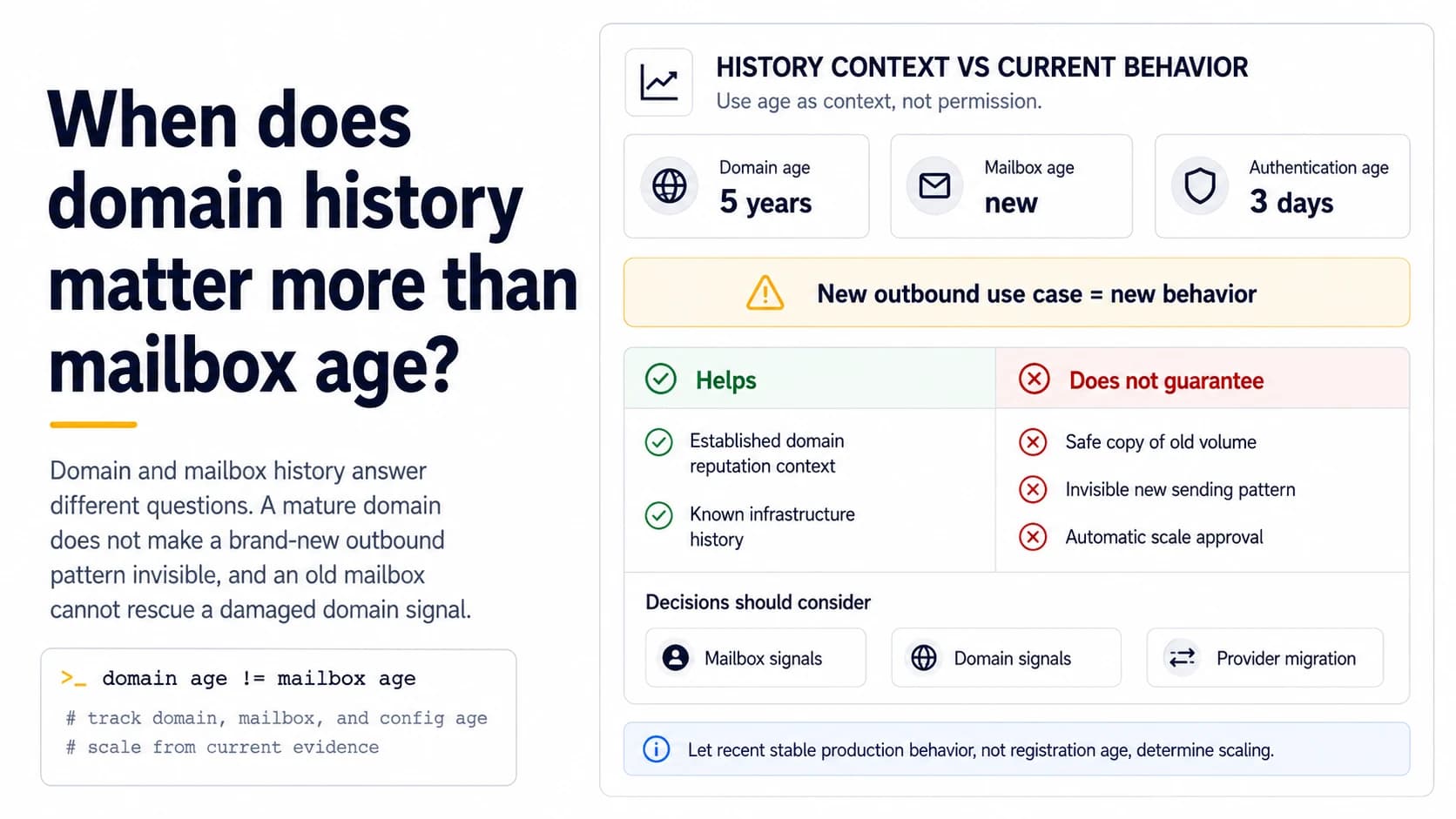
Domain and mailbox history answer different questions; a long-lived domain cannot make a brand-new sending pattern invisible, and an old mailbox cannot rescue a damaged domain signal.
Read field note →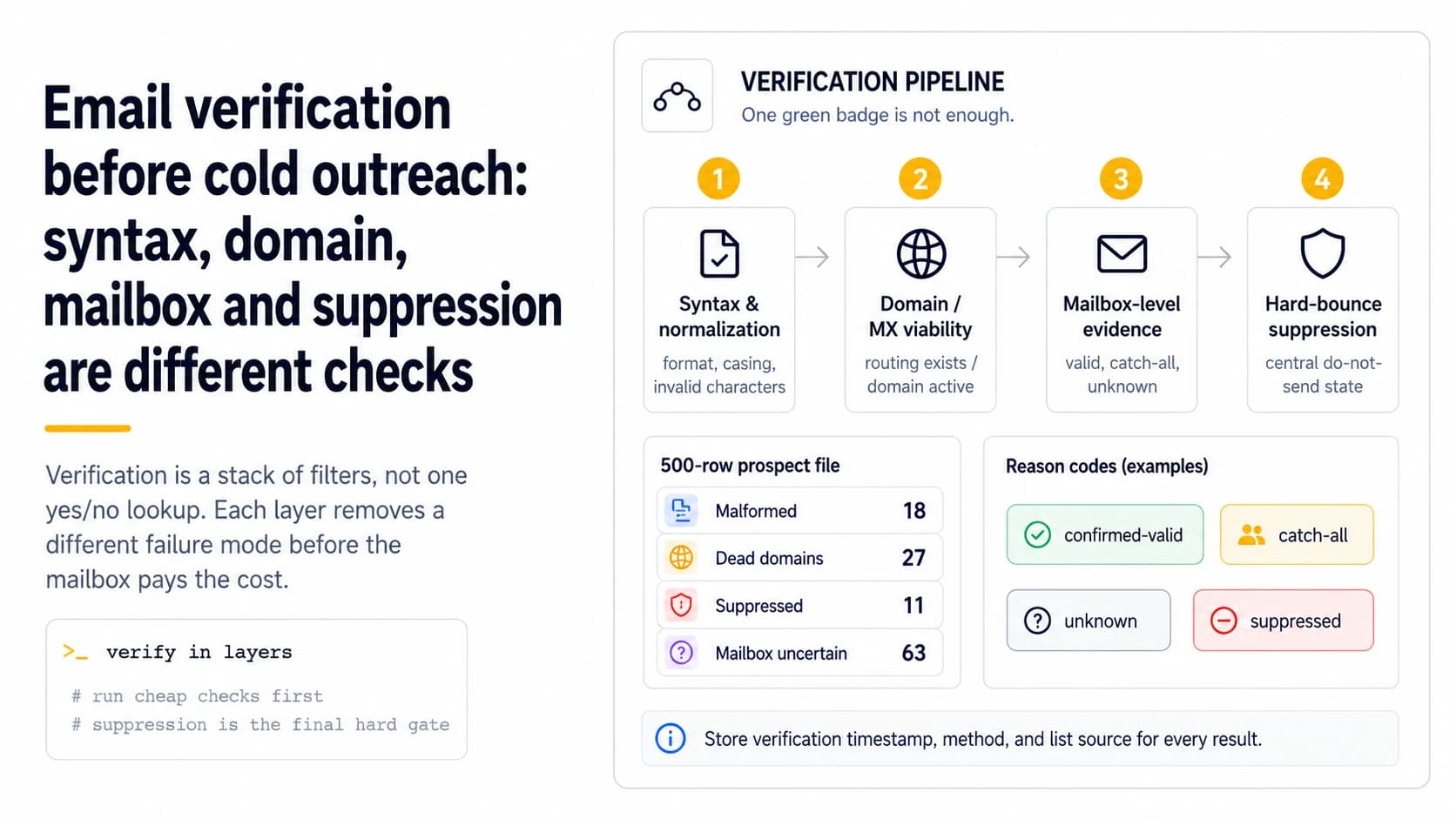
Verification is a stack of filters, not one yes/no lookup; each layer removes a different failure mode before the mailbox pays the cost.
Read field note →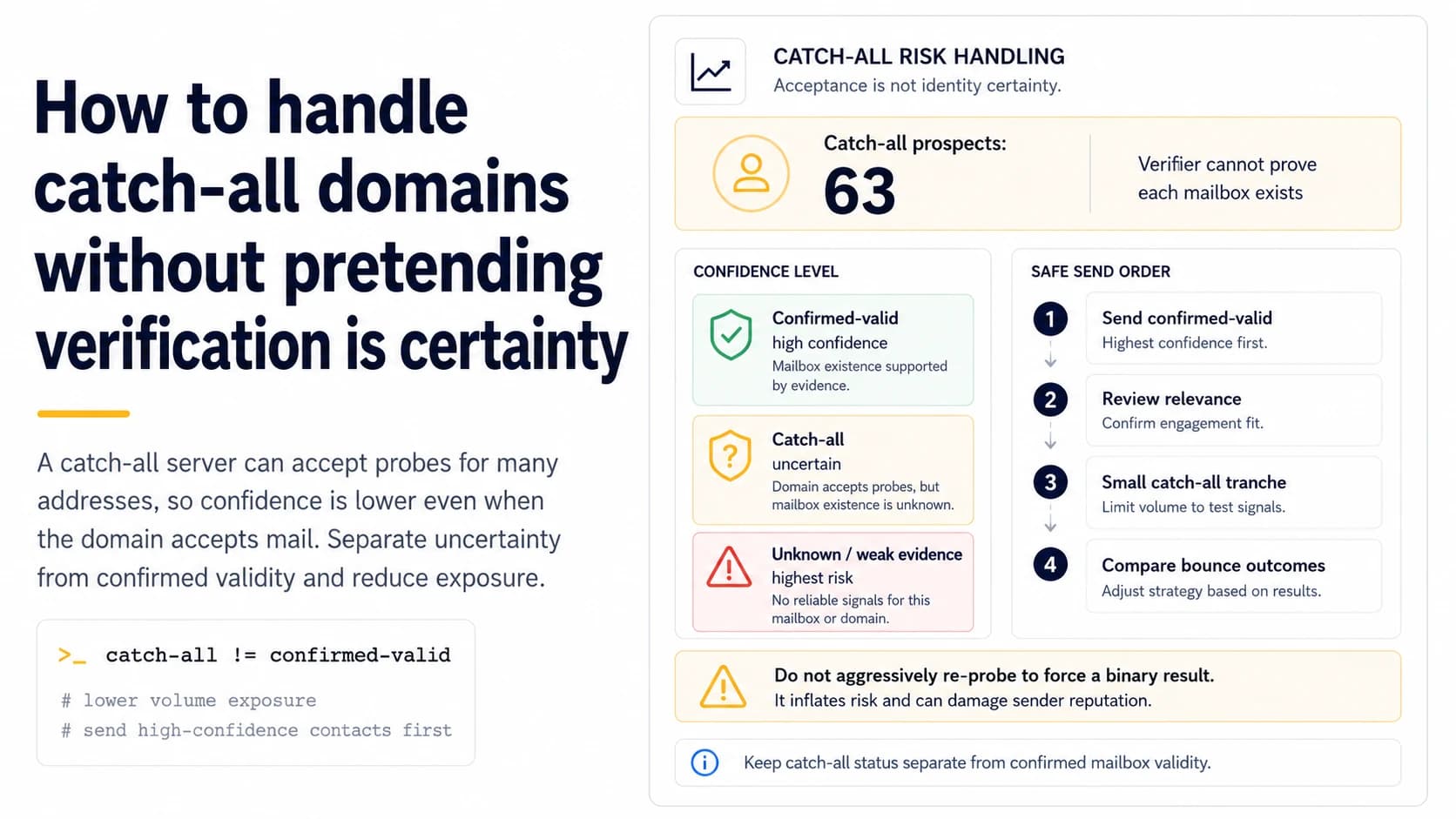
A catch-all server can accept probes for many addresses, so verification confidence is lower even when the domain accepts mail.
Read field note →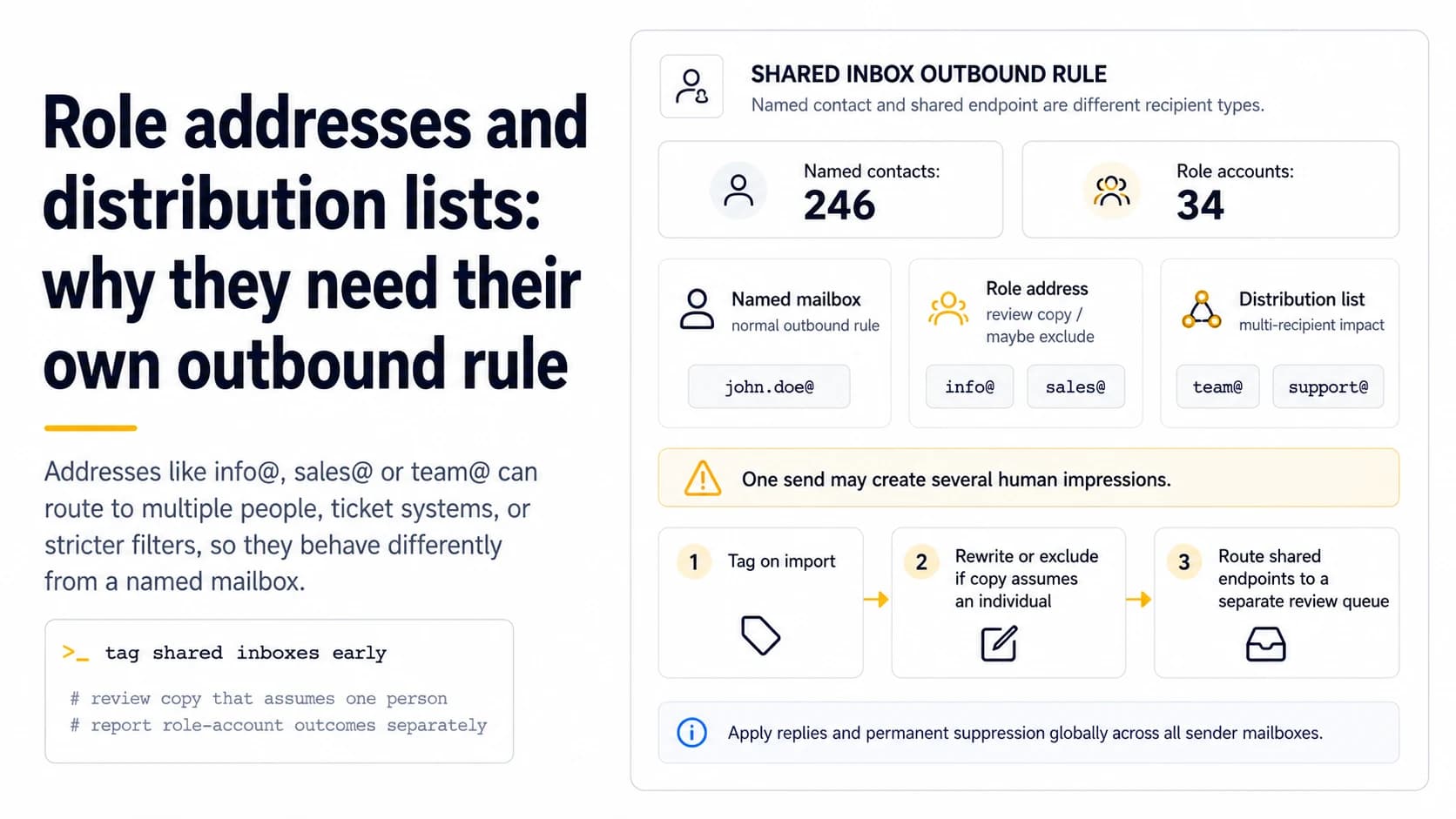
Addresses like info@, sales@ or team@ can route to multiple people, ticket systems or stricter filters, so they behave differently from a named mailbox.
Read field note →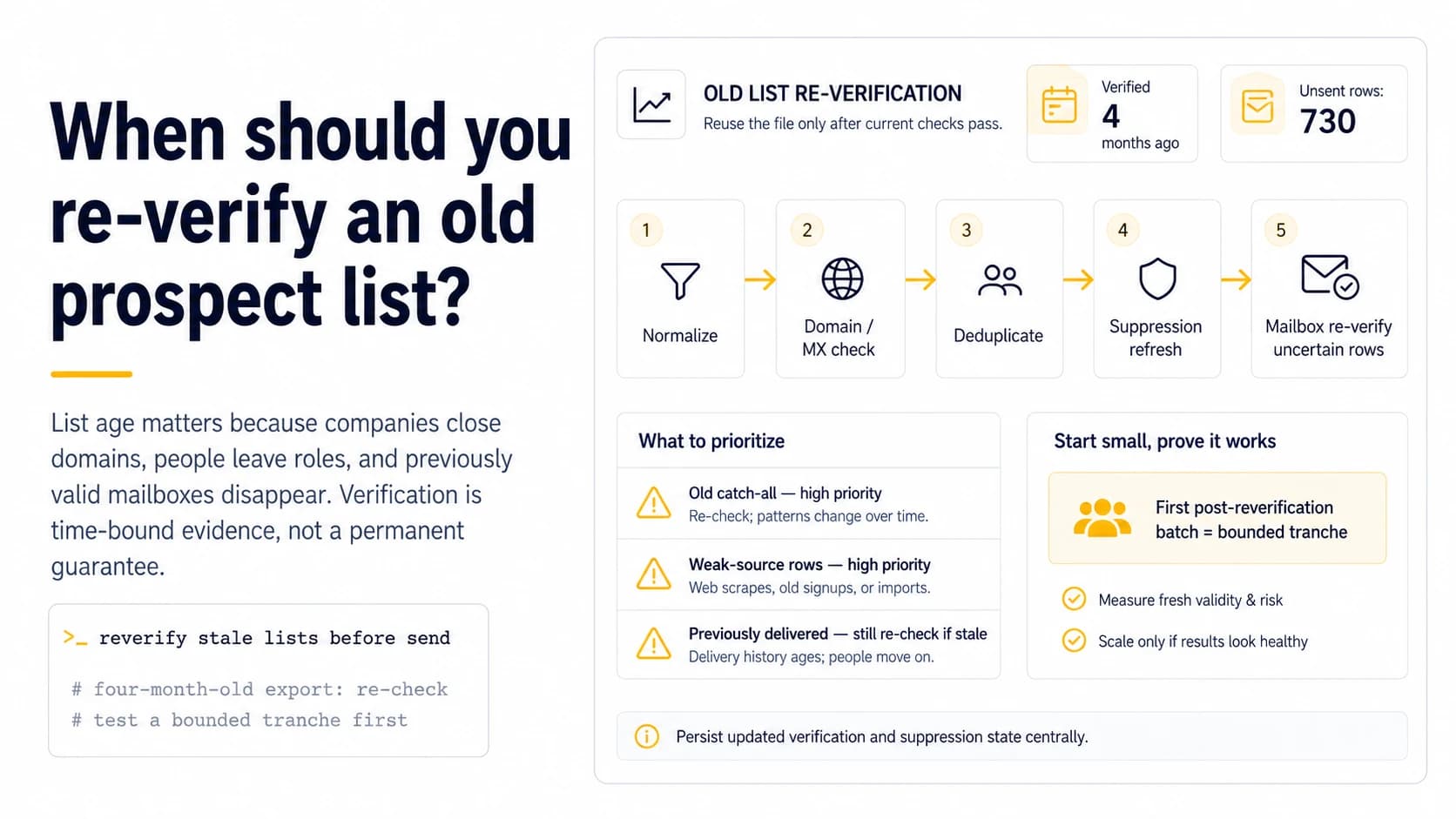
List age matters because companies close domains, people leave roles and previously valid mailboxes disappear.
Read field note →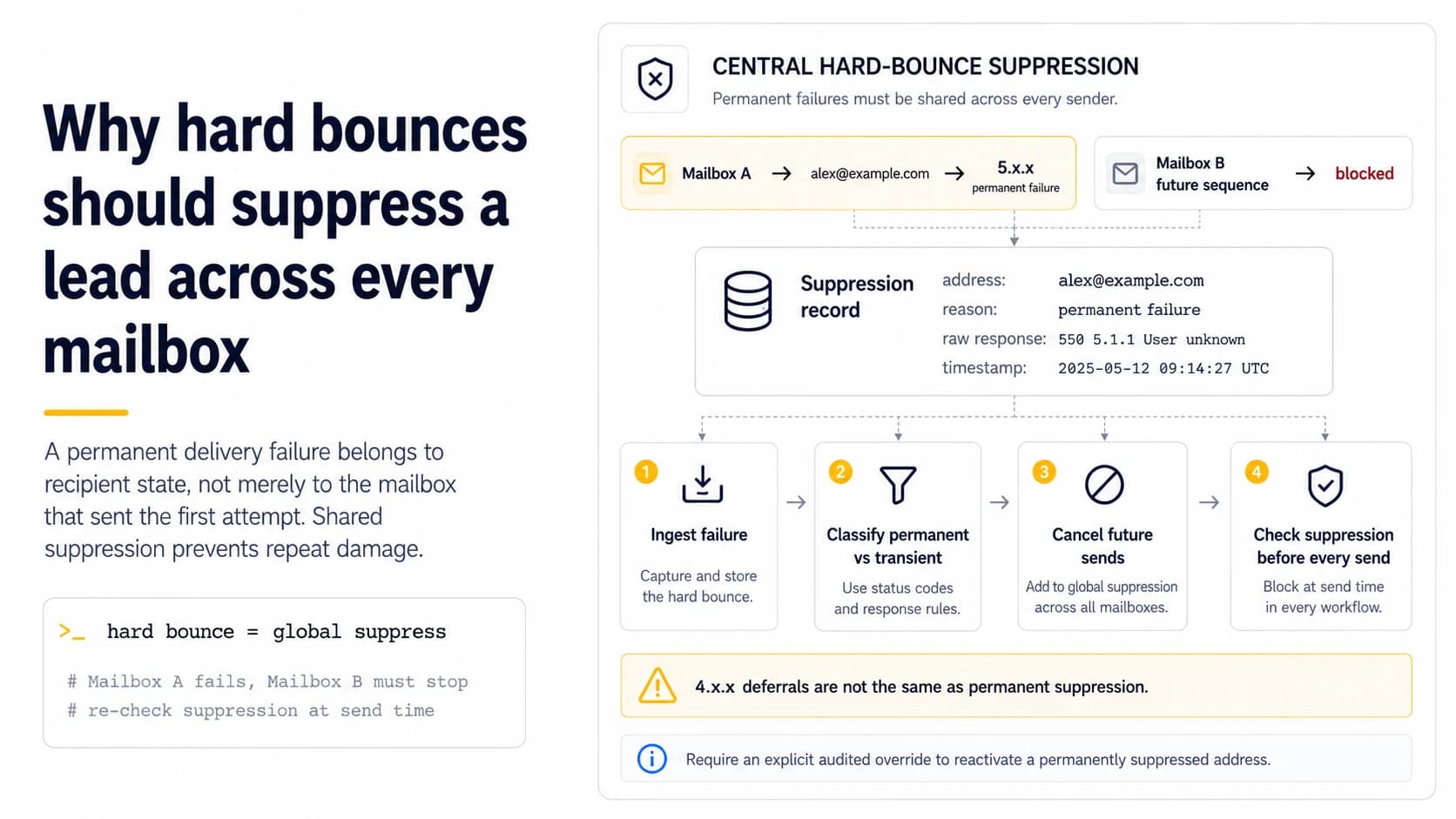
A permanent delivery failure belongs to the recipient state, not merely to the mailbox that happened to send the first attempt.
Read field note →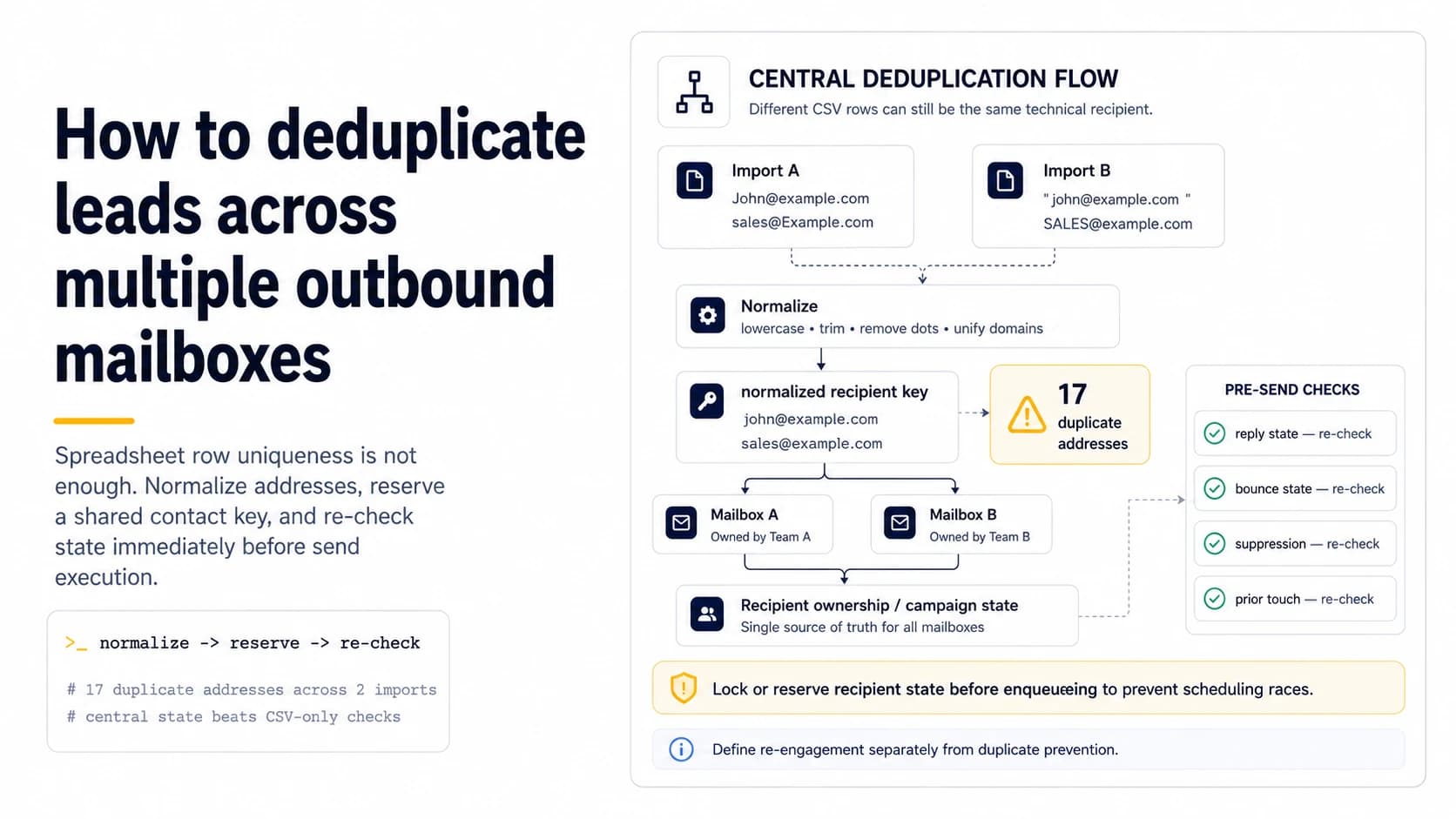
Deduplication needs a stable recipient key and campaign state; spreadsheet row uniqueness is not enough when data enters through multiple sources.
Read field note →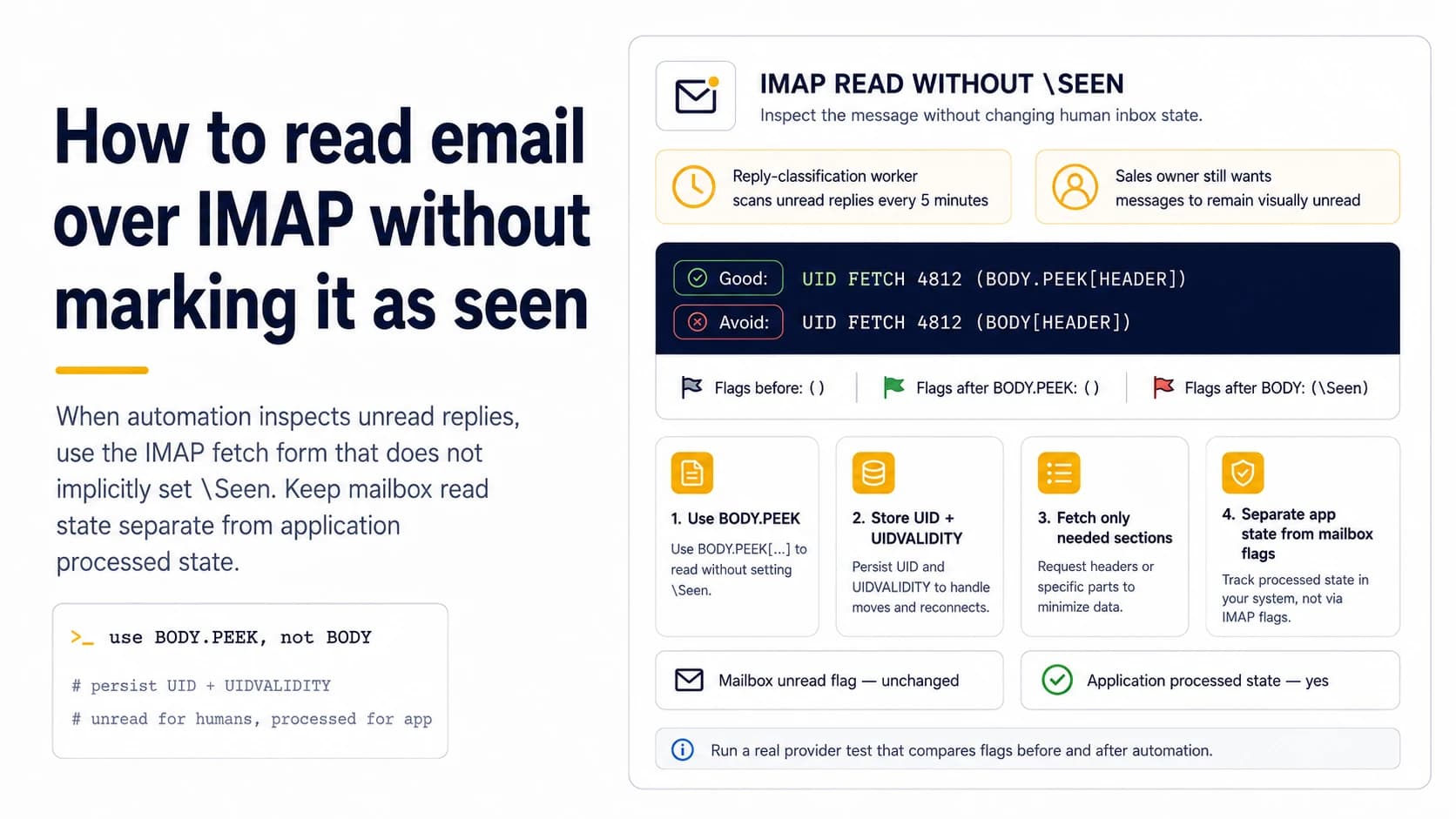
Use a fetch form that does not implicitly set the \Seen flag when the automation should inspect a message without changing the human inbox state.
Read field note →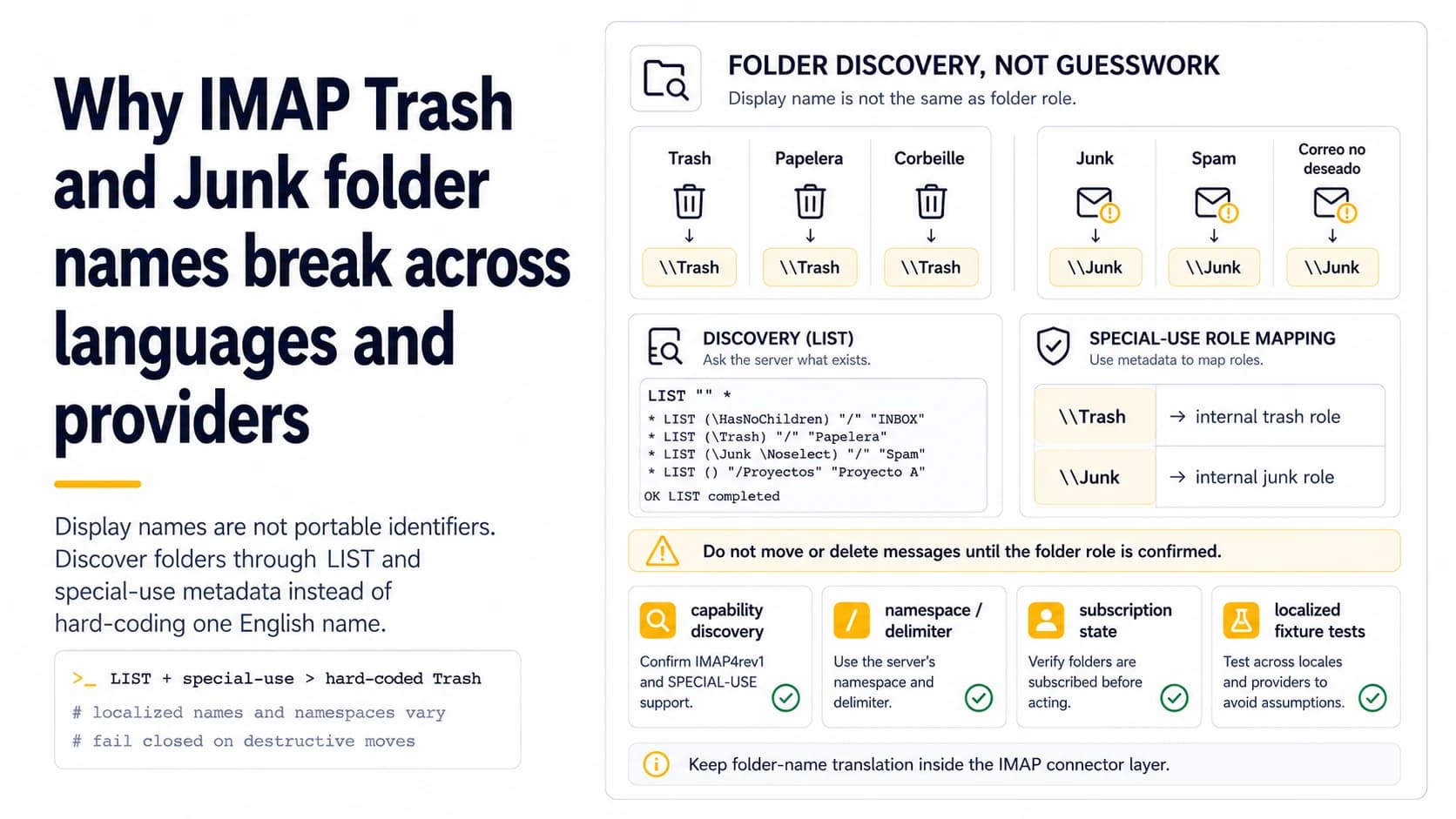
Display names are not portable identifiers; providers can expose localized or vendor-specific mailbox names.
Read field note →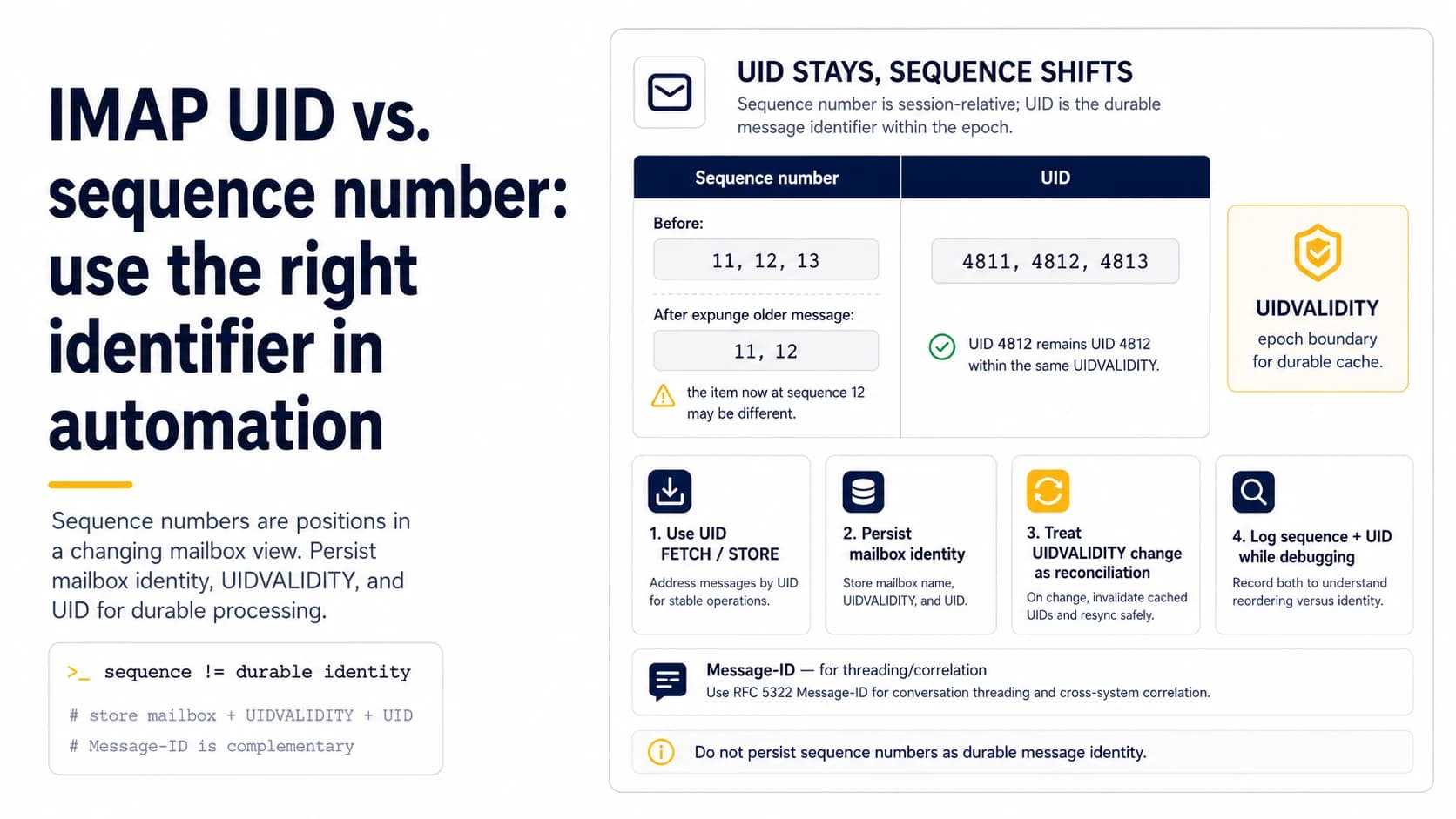
Message sequence numbers can change as the mailbox changes; UIDs are designed to remain stable within a UIDVALIDITY epoch.
Read field note →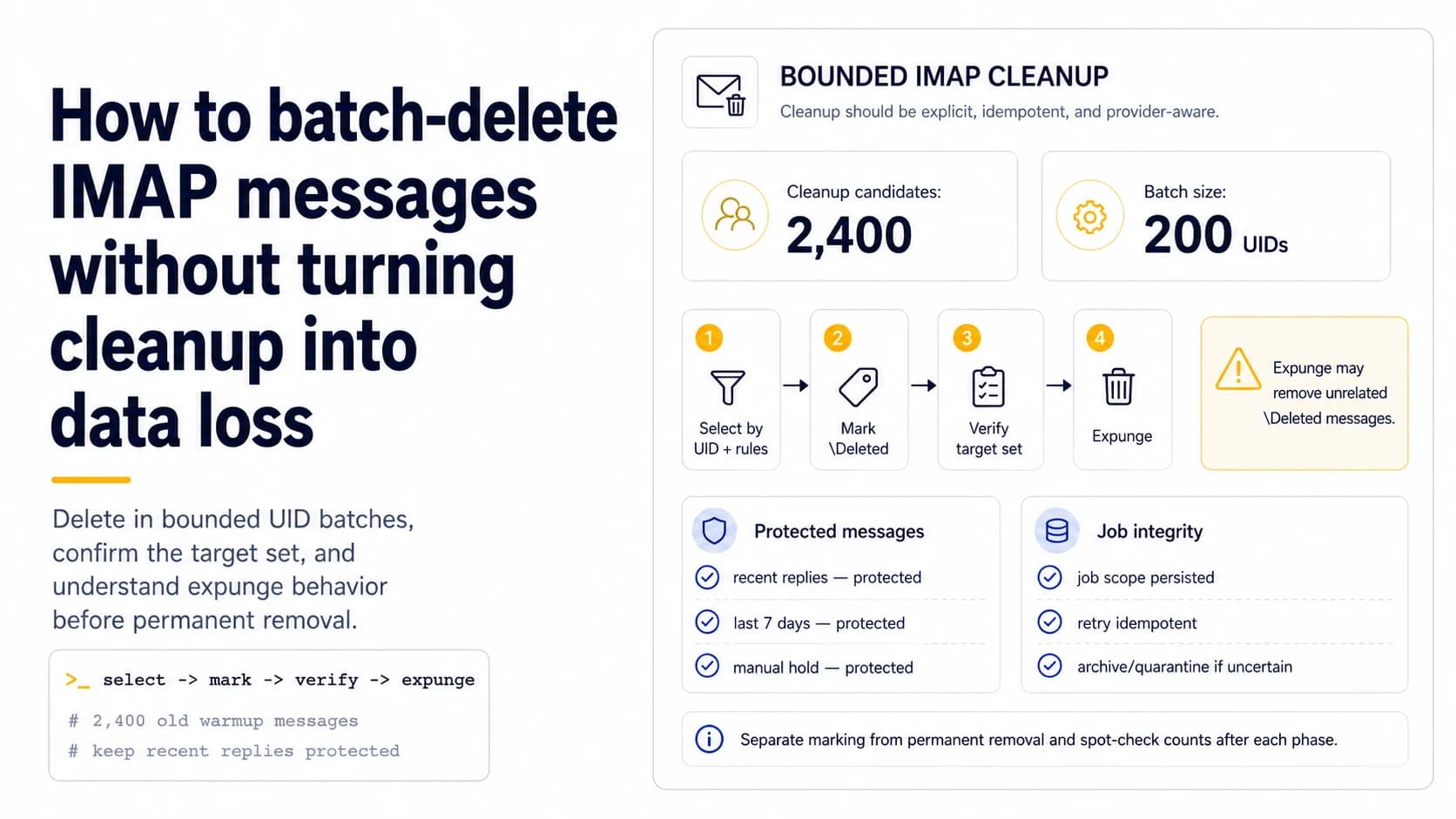
Deletion is normally a flagging operation followed by expunge semantics; automation should define exactly which messages are eligible before removal.
Read field note →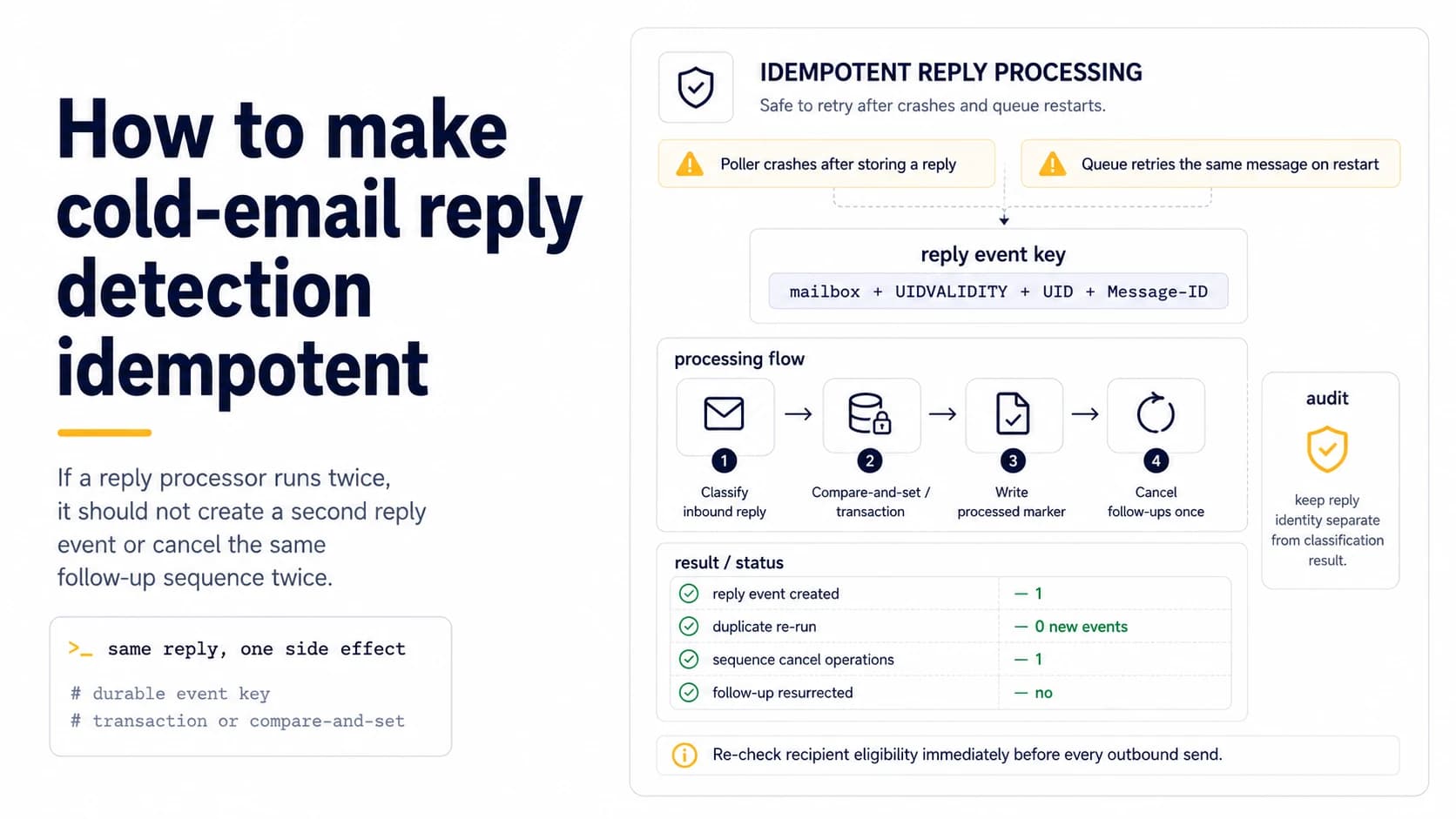
A reply processor should be safe to run twice: the second pass must not create a second reply event, cancel the same sequence twice or resurrect follow-ups.
Read field note →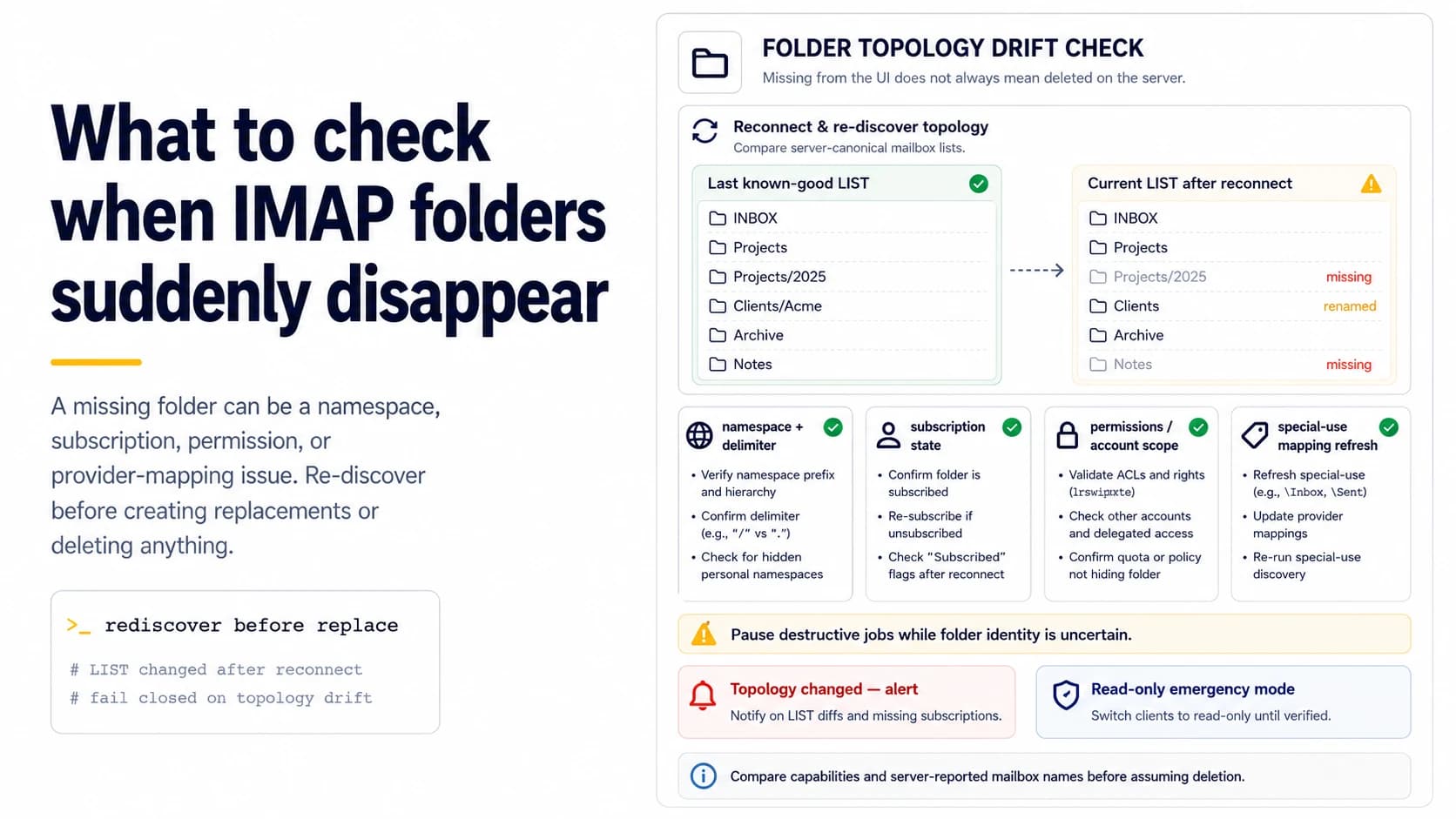
Missing folders can be a namespace, subscription, permission or provider-mapping issue; it is not always deletion.
Read field note →Spacing should give a real person time to respond and the system time to process state; there is no protocol-defined universal cadence.
Read field note →A sequence should have an explicit maximum touch count and stop conditions; indefinite follow-up converts uncertainty into repeated unwanted mail.
Read field note →The safest follow-up is the one never sent after a recipient has already replied.
Read field note →Threading preserves context when headers and provider behavior support it, but your system should not fake relationships it cannot reliably reconstruct.
Read field note →Scheduling should store the recipient or campaign timezone assumption explicitly and compute the next eligible business window at execution time.
Read field note →Out-of-office messages are replies for state handling but not necessarily human interest; classify them separately from positive, negative and neutral responses.
Read field note →Look for directional changes across bounces, deferrals, complaints, replies and provider-specific filtering rather than waiting for a single binary blacklist event.
Read field note →Classify permanent versus transient failures, group by recipient domain and compare against list source before touching copy or DNS.
Read field note →Treat a complaint as strong evidence that recipient experience is wrong; reduce exposure while you inspect targeting, frequency and suppression state.
Read field note →Pause when the failure mode is unknown or structural; reduce when the system is understood and you are testing a controlled return to a known-good state.
Read field note →When authentication breaks immediately after DNS work, preserve the timeline and verify the exact record, selector, propagation path and message headers before changing campaigns.
Read field note →A quiet period changes recent behavior, so return in measured steps instead of assuming the last historical peak remains the right starting point.
Read field note →Adding one legitimate sender can push an existing SPF policy over protocol limits because nested include mechanisms also consume DNS lookups. Diagnose the evaluation path before deleting or flattening records.
Read field note →A migration can leave the old provider’s SPF policy beside the new one. Receivers do not merge two v=spf1 records at the same hostname; the result can be SPF PermError.
Read field note →When DKIM reports a body-hash mismatch, the public key can be perfectly correct. The more useful question is whether something changed the message body after the DKIM signer calculated bh=.
Read field note →DKIM rotation is safer when the new key is published and verified before signers switch, while the old selector remains resolvable long enough for queued or delayed messages to finish verification.
Read field note →A DKIM selector is one DNS name. If a migration leaves both provider-hosted CNAME data and a self-hosted TXT key at that exact name, DNS semantics and DKIM lookup behavior become unreliable.
Read field note →The old pct tag from RFC 7489 is no longer part of the current DMARC base specification. Small senders should stage enforcement through testing, reporting, scoped subdomains, and controlled policy changes instead of assuming percentage rollout.
Read field note →RFC 9989 distinguishes policy for existing subdomains with sp from policy for nonexistent subdomains with np. Understanding the distinction prevents a root DMARC record from being interpreted too broadly.
Read field note →When aggregate reports are sent to a mailbox on a different domain, DMARC reporting has an authorization step intended to prevent report amplification. A syntactically valid rua value alone may not be enough.
Read field note →SPF authenticates the SMTP envelope identity, commonly exposed as Return-Path. DMARC then asks whether that authenticated domain aligns with the RFC5322 From domain the recipient sees.
Read field note →Blank Postmaster charts do not prove a domain is healthy or broken. Google suppresses or omits some data when there is not enough eligible traffic, so small senders need direct operational signals as well.
Read field note →Gmail 421 4.7.28 is a temporary rate-limit response. The exact diagnostic can point at an IP, SPF domain, DKIM domain, URL domain, or repeated Message-ID, so keep the full text before deciding what to reduce.
Read field note →Outlook.com can reject high-volume sender mail with 550 5.7.515 when the sending domain does not meet required authentication. Diagnose the actual production message, not only DNS screenshots.
Read field note →Yahoo documents TS-style “message temporarily deferred” errors as temporary and associates them with signals such as unusual traffic patterns, complaints, content characteristics, and poor IP reputation.
Read field note →SMTP reply classes describe temporary versus permanent outcomes. A suppression engine should not erase a prospect merely because any delivery attempt failed.
Read field note →SMTP defines 4xx as temporary but does not give one universal cold-outreach retry duration. The transport queue and the business workflow need separate expiration rules.
Read field note →IMAP UIDs are only stable within a mailbox while UIDVALIDITY remains the same. If UIDVALIDITY changes, cached UIDs from the old validity value can no longer be trusted as identities in the new mailbox state.
Read field note →IMAP IDLE can notify a connected client about mailbox changes, but TCP sessions and servers can drop. Reply detection needs reconnect and catch-up logic instead of assuming one IDLE session lives forever.
Read field note →IMAP distinguishes read-write and read-only selected mailboxes. If a mailbox is opened with EXAMINE or the server grants only read-only access, permanent state changes and expunge behavior are restricted.
Read field note →Standard Delivery Status Notifications can use multipart/report with a message/delivery-status part that carries structured per-recipient fields. Parsing that structure is more reliable than matching “Undeliverable” in the subject.
Read field note →RFC 3834 recommends Auto-Submitted: auto-replied for automatic responses. It is a strong signal for vacation and automatic replies, but real systems still need a layered classifier because not every provider follows the standard perfectly.
Read field note →UNSEEN describes mailbox read state, not whether your automation processed a message. Human activity, mobile clients, filters, and other workers can change the Seen flag before your reply detector runs.
Read field note →UIDNEXT predicts the next UID value assigned to a future message. It can tell a client that mailbox state may have changed, but it does not guarantee a particular message exists with that UID.
Read field note →SMTP historically allows fallback to the domain’s address record when no MX exists, while a Null MX explicitly signals that a domain accepts no email. “No MX” is therefore not identical to “cannot receive.”
Read field note →NXDOMAIN means the queried domain name does not exist in DNS. A domain that exists but lacks MX records is a different condition and can still have SMTP fallback behavior.
Read field note →Mailbox verification can receive temporary SMTP responses because of greylisting, rate controls, recipient-server load, or policy. A 4xx probe result is uncertainty, not proof that the mailbox does not exist.
Read field note →Mailbox-full conditions are often reported as temporary 4.2.2-style responses, but provider wording and persistence vary. Treat the first event as temporary unless the receiver explicitly returns a permanent failure.
Read field note →A second mailbox is a new sending identity even when the domain has history. If each mailbox inherits the old cap independently, total domain traffic can jump overnight.
Read field note →An established organizational domain does not make a newly used sending subdomain instantly proven. The subdomain may have new SPF, DKIM, Return-Path, and traffic history that receivers have not observed before.
Read field note →A mature domain can have healthy history while a newly created mailbox has no sending pattern of its own. Introduce the mailbox gradually and count its traffic inside the domain total.
Read field note →A weekend pause changes recent traffic shape. Backlogged queues and “catch up” logic can compress several days of intended sends into Monday morning, creating bursts that were never part of the normal pattern.
Read field note →A short SPF TXT record can exceed the protocol lookup budget after nested includes are expanded. Trace the evaluated tree instead of counting only the mechanisms you can see at the root.
Read field note →SPF has a second processing guard that many dashboards omit: implementations should limit void lookups such as NXDOMAIN or empty answers, with two recommended by RFC 7208.
Read field note →Replacing provider includes with literal IP ranges reduces DNS work but removes automatic inheritance of the provider’s future infrastructure changes. That maintenance trade-off is easy to miss.
Read field note →Gmail’s sender errors distinguish a temporary rate limit from a permanent block, but both can point to the same infrastructure defect: missing or inconsistent forward and reverse DNS.
Read field note →Gmail’s 4.7.29 code says the sending connection is not using TLS where Google requires it. Authentication changes will not repair a plaintext transport path.
Read field note →Current DKIM crypto guidance requires RSA keys of at least 1024 bits and recommends at least 2048. A selector rotation is the safest time to check both algorithm and key length.
Read field note →DKIM canonicalization is often misunderstood as permission for gateways to rewrite messages. Relaxed mode tolerates defined formatting changes; it does not make arbitrary footer or link modification safe.
Read field note →RFC 9989 changes how DMARC policy discovery and the organizational domain are determined. The new DNS Tree Walk can differ from older PSL-based explanations and tooling.
Read field note →The old ri tag for requested aggregate-report intervals is marked historic in the current DMARC registry. RFC 9990 describes reports as typically daily or more frequent without restoring ri.
Read field note →RFC 9989 explicitly removes the ability to specify a maximum report size in the DMARC reporting URI. Old rua examples with a !size suffix should not be copied into current templates.
Read field note →Publishing List-Unsubscribe and List-Unsubscribe-Post is not enough for RFC 8058 one-click behavior. The message needs a valid DKIM signature that covers those headers.
Read field note →A domain can explicitly say it accepts no mail with a null MX, omit MX and rely on SMTP fallback behavior, or not exist at all. Those states have different meanings.
Read field note →A resolver failure is not proof that a recipient domain does not exist. Verification systems need a temporary DNS state that can be retried without poisoning suppression data.
Read field note →SMTP verification sees the behavior of the address you connect to, not every downstream hop that a forwarder may use after acceptance. Treat forwarding as a limit on certainty.
Read field note →A temporary-email provider can publish valid DNS and accept mail normally. Classifying it as disposable may be useful for your lead policy, but it should not be mislabeled as SMTP invalidity.
Read field note →If multiple mailboxes can contact the same lead, a per-mailbox unsubscribe flag is too narrow. The sending scheduler needs a shared suppression decision before any future queue run.
Read field note →Yahoo’s CFL is DKIM-based. A useful small-sender workflow connects the complaint to the signing domain and recipient suppression instead of treating it as an abstract reputation metric.
Read field note →Gmail exposes labels through IMAP folder-like behavior and provides a stable message identifier extension. Automation that scans multiple labels needs a deduplication key above per-folder UIDs.
Read field note →The IMAP flags describe state on a stored message. They do not prove who generated a new inbound reply, and different clients can set or ignore them in ways that break outbound automation assumptions.
Read field note →A reconnect can change message sequence numbers while stable UIDs remain valid inside the same UIDVALIDITY epoch. Incremental workers should resume with UID-based ranges and validate the epoch first.
Read field note →RFC 5322 says messages should have globally unique Message-ID values, but automation still needs a fallback when malformed or duplicated identifiers appear in real mail.
Read field note →Ordinary EXPUNGE can remove every message currently carrying \Deleted in the selected mailbox, including flags set by another client. UID EXPUNGE narrows the destructive action to chosen UIDs when supported.
Read field note →IMAP servers advertise a hierarchy delimiter in LIST responses. Hard-coding “/” can break mailbox discovery on servers that use another delimiter or have a flat namespace.
Read field note →Gmail exposes X-GM-THRID for its own thread model, while RFC 5322 uses Message-ID, In-Reply-To and References. Outbound reply systems benefit from keeping both layers.
Read field note →People reply from delegated accounts, aliases, assistants, or another mailbox. A detector that requires the inbound From address to equal the original lead can miss a real conversation.
Read field note →Polling for replies and dequeuing follow-ups are concurrent processes. Without a final state check, a perfectly detected reply can still lose a race to a job that was already claimed.
Read field note →RFC 3834 recommends Auto-Submitted markers on automatic responses and says automatic responders should not blindly answer messages that are themselves automatically submitted.
Read field note →RFC 8058 defines the one-click POST shape. The application behind the URL still needs safe repeat handling because receivers, users, or retries can submit the same opt-out more than once.
Read field note →Temporary SMTP failures invite a future retry, but aggressive immediate retries can amplify the rate pattern that triggered deferral in the first place. Queue discipline matters.
Read field note →Resolvers cache negative DNS answers as well as positive records. After correcting a missing MX or related name, some paths can continue seeing the earlier negative result until its cache lifetime expires.
Read field note →