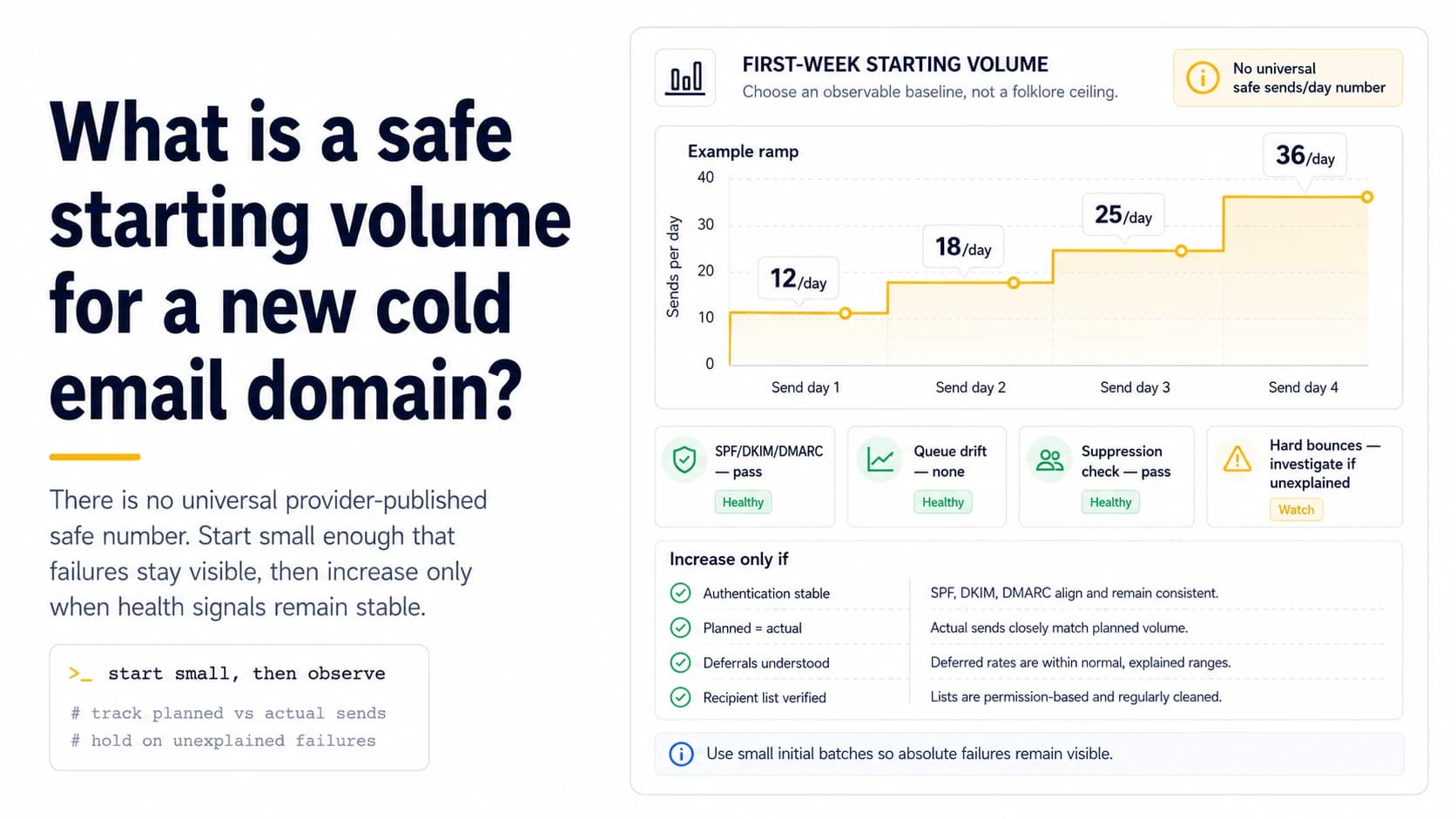
There is no provider-published cold-email safe number
A new domain does not come with a documented allowance such as 20, 40, or 80 cold emails per day. Major receivers publish authentication, abuse, and spam-rate requirements, but they do not certify a universal prospecting volume that guarantees inbox placement. That distinction matters because “safe sends/day” tables often combine anecdotes from different providers, list quality, and domain histories. For a solo sender, the useful starting number is one small enough that failures are visible and reversible. The first batch is a diagnostic batch, not a quota negotiation with Gmail or Outlook.
Start small enough to learn from absolute counts
Suppose the list contains 120 verified prospects and the mailbox has never sent outbound. A first batch of five to ten messages is operationally useful because one hard bounce, one authentication error, or one policy deferral is impossible to hide inside a percentage. If the same failure appears in a batch of eighty, the sender has exposed far more recipients before learning the same lesson. This does not make five a magic number. It illustrates the principle: early batches should minimize the cost of discovering a configuration or data problem.
Verify infrastructure before the first prospect sees mail
Before choosing any ramp, send controlled test messages and inspect SPF, DKIM, and DMARC alignment from received headers. Confirm that the queue sends exactly once, suppression is consulted before execution, and replies can stop later touches. A volume plan cannot compensate for a broken DKIM selector or a duplicate worker. New-domain testing should therefore happen in layers: identity first, workflow second, then a small real-recipient tranche. If any lower layer is unstable, raising the daily cap only increases the blast radius.
Use a ramp to bound change, not to predict reputation
An illustrative sequence such as 5, 7, 9, 12, 15, 18, and 22 can force an operator to make small deliberate changes. The numbers are not a promise from a receiver and should not advance automatically because another calendar day passed. Record planned sends and actual sends, then gate the next step on what happened in the prior batch. A clean batch means “this state was observable and acceptable enough for one bounded test,” not “the mailbox has earned all later steps on the spreadsheet.”
Count real traffic across every mailbox on the domain
A domain with three mailboxes can change behavior sharply even when each account looks conservative in isolation. If each mailbox sends 20 similar prospect messages in the same hour, the domain produces 60 messages with a shared pattern. Track per-mailbox and per-domain totals together, including warmup or transactional traffic if it shares the domain. A new account added to an established domain should also ramp its own behavior; domain history is context, not a transferable daily allowance.
Hold the ramp when the evidence becomes ambiguous
Pause the increase if hard bounces rise above the recent baseline, authentication changes, a provider begins returning 4.x.x deferrals, complaints appear, or actual queue output exceeds the plan. Temporary failures are especially easy to mishandle: blindly retrying them can turn a small rate signal into a burst. Preserve the exact SMTP response and recipient domain, then decide whether the cause is list quality, provider throttling, infrastructure, or a worker bug. The next experiment should isolate that cause rather than simply wait 24 hours and send more.
Define the working range from production behavior
The eventual daily range should come from repeatable real outbound, not from a warmup score or a blog benchmark. As verified prospect batches grow, watch authentication, permanent failures, temporary deferrals, genuine replies, negative replies, and complaints where visible. Keep copy and list source reasonably stable during each comparison. When the system can repeat a healthy pattern at the intended workload, that becomes the local operating baseline. It can still change later; reputation and receiver policy are dynamic, which is why the sender keeps measuring rather than declaring a permanent safe number.
Use provider limits as warning context, not a cold-email quota
Large mailbox providers publish authentication and abuse thresholds, but they do not publish a universal “safe cold outreach sends per mailbox” number. Gmail, for example, focuses on authentication, DNS, TLS, complaint rates and compliant behavior; Yahoo likewise emphasizes complaint rate, valid DNS, RFC compliance and controlled traffic. Those requirements tell you what can trigger filtering or rejection, not what volume will guarantee inbox placement. For a new domain, a useful starting batch is one small enough that a single bad address, queue bug or authentication failure is obvious and cheap to investigate. If ten messages already reveal a defect, sending fifty would only enlarge the incident. Define the first cap from observability and list quality, then let real outcomes determine the next cap.
A concrete first-week decision table
Consider a mailbox planned at 5, 7, 9, 12 and 18 sends over five working days. After each day, record actual sends, permanent address failures, temporary receiver deferrals, genuine replies and authentication results. If actual sends exceed the plan, fix scheduling before increasing. If a hard bounce occurs, suppress the address and inspect the list segment. If a temporary rate-limit code appears, hold or lower the next batch while confirming the traffic pattern. If all checks are normal, the next planned step is reasonable as an experiment, not a guarantee. The value of this table is that every increase has an explicit reason. By the end of the week, the operator has a measured operating history instead of a folklore number borrowed from someone else’s domain.
Do not use open rate as the main ramp signal
Open tracking is a weak operational signal for sender health because privacy features, image caching and client behavior distort it, and Google explicitly notes that it does not track open rates in its sender guidance. A new domain should be advanced on signals the sender can verify more directly: authentication, actual send count, permanent failures, temporary receiver responses, complaint data where available and genuine replies. If an open-rate dashboard says 80% while the domain is receiving rate-limit deferrals, the deferrals deserve more weight. Likewise, a low open rate on a tiny batch is not a reason to rewrite DNS. Keep content-performance metrics separate from deliverability and infrastructure health.
Field checklist
- Reject universal “safe sends/day” claims that are not receiver-published.
- Test SPF, DKIM, DMARC, queue idempotency, and suppression before real prospect volume.
- Use small initial batches so absolute failures stay visible.
- Track planned versus actual sends at mailbox and domain level.
- Hold increases on unexplained bounces, deferrals, complaints, or worker spikes.
- Let stable real outbound define the working range, not a warmup score.
Primary sources
Standards and provider policies can change. These links are the reference points used for this field note.
- Email sender guidelinesGoogle Gmail Help — Authentication, TLS, DNS, spam-rate and bulk-sender requirements.
- Outlook requirements for high-volume sendersMicrosoft Defender for Office 365 Blog — SPF, DKIM and DMARC requirements for high-volume mail to Outlook.com consumer domains.
- Sender Requirements & RecommendationsYahoo Sender Hub — Yahoo authentication, complaint-rate, DNS, unsubscribe and flow-control requirements and recommendations.