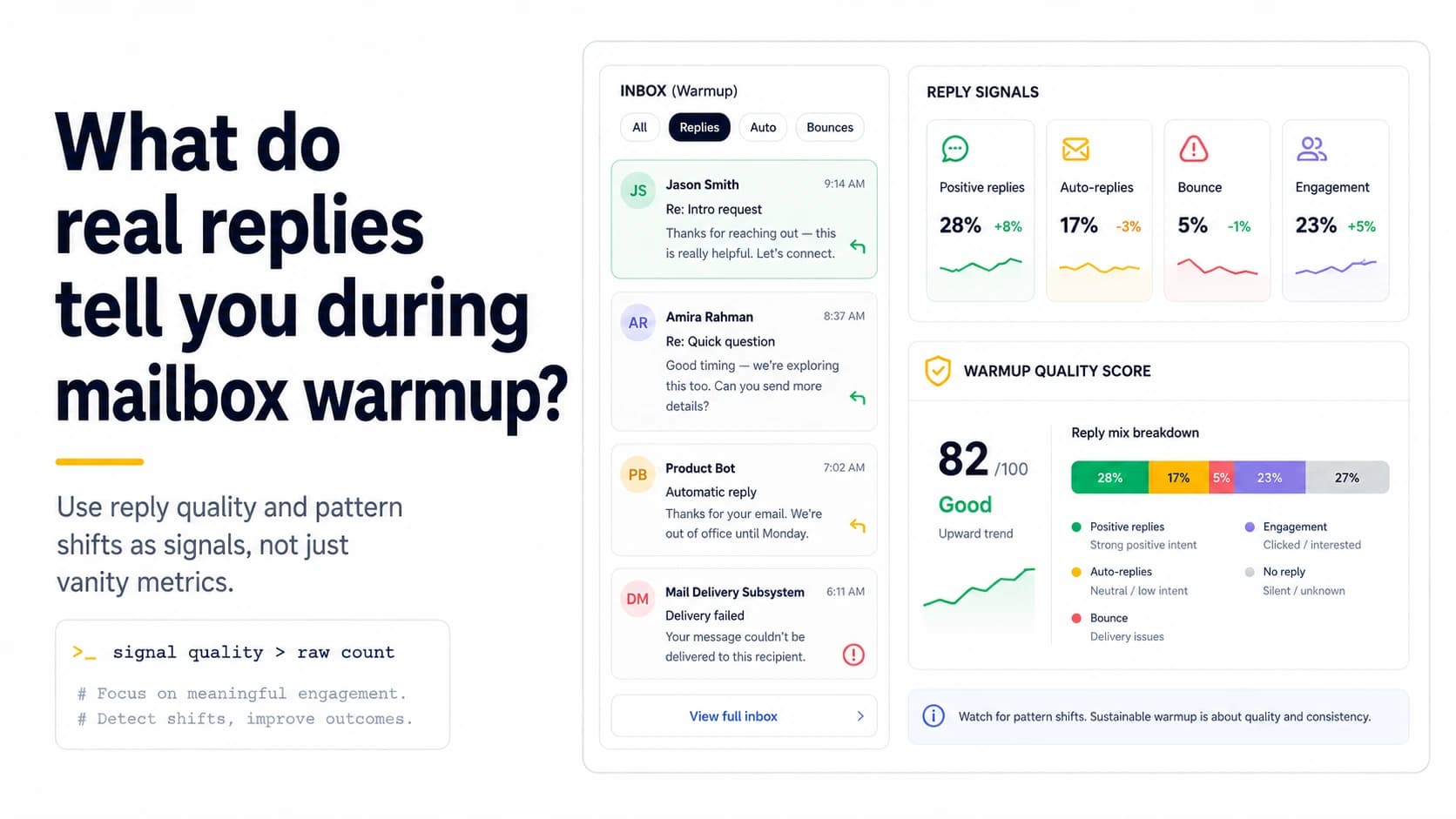
A reply proves engagement from one recipient, not global placement
Real replies are valuable because they show that at least some messages reached people who were willing to respond. They do not prove that the mailbox is universally reaching the inbox, that the list is clean, or that authentication is correct for every message path. If a fourteen-message batch receives three human replies, one out-of-office response and one hard bounce, each event belongs to a different operational category. The human replies are positive engagement evidence, the automatic response should change follow-up state, and the hard bounce should update suppression. Calling the whole batch 'healthy because reply rate is high' throws away the most useful detail.
Classify inbound mail before using it as a metric
A reply processor should distinguish human interest, human rejection, neutral questions, out-of-office notices, automated ticket responses and delivery-system messages. These categories affect the sequence differently. A negative human reply is still proof that the person received and processed the message, but it should stop future follow-ups. An out-of-office reply should normally pause immediate automation without being counted as a positive sales response. A delivery-status notification is not a prospect reply at all. Warmup analysis improves when inbound events are classified by what they mean rather than simply counted as 'replies.'
Do not let replies hide list-quality damage
Small batches can produce mixed signals. Suppose two prospects reply positively while three other recipients return permanent address failures. The positive conversations are encouraging, but the three invalid addresses still indicate a hygiene problem. Suppress them globally and investigate the list source before increasing. A mailbox can receive good engagement and still accumulate avoidable negative delivery events. The useful question is whether the whole operating system is behaving predictably: authentication passes, known dead addresses are not retried, replies stop follow-ups, and planned sends match actual sends.
Use reply timing to test your state machine
Warmup is a good time to verify that the outbound system reacts correctly when a person responds. If a reply arrives at 10:12 and a follow-up is scheduled for noon, the send-time worker should check the latest recipient state and cancel the later message. If the worker cannot do that at low volume, scaling the campaign will only make the error more visible. Record the inbound message identifier and processing time, then verify that the lead enters a single replied state. This is especially important when IMAP polling or webhooks can deliver the same event more than once.
Preserve unread state when automation is only inspecting
When a mailbox is shared with a human operator, reply classification should not accidentally mark every message as read unless that is an intentional workflow decision. IMAP4rev2 provides BODY.PEEK as a fetch form that does not implicitly set the \Seen flag. That detail matters because unread state is often part of a human review queue. Technical warmup should include this test early: let the worker inspect a reply, confirm the database state changes once, and confirm the mailbox still presents the message according to the team's chosen unread/read policy.
Measure replies against comparable prospect sets
Reply rate is hard to interpret when list quality and targeting change at the same time. A ten-message batch to highly relevant founders should not be compared directly with fifty messages to a broader scraped segment. During warmup, keep the prospect criteria stable enough that reply changes mean something. This does not require scientific experimentation; it requires basic discipline about list source, message type and batch size. If replies collapse immediately after switching to a new source while authentication and volume remain stable, targeting or data quality becomes a stronger hypothesis than 'the domain suddenly lost reputation.'
What a healthy reply signal looks like operationally
The useful milestone is not a specific reply percentage. It is a system that treats inbound mail correctly: human replies are recognized, follow-ups stop before send time, automatic responses are classified separately, and delivery failures never inflate the reply metric. Combine that behavior with stable authentication and controlled recipient failures before increasing volume. A mailbox that generates genuine two-way conversations but has broken suppression or duplicate follow-ups is not operationally ready, even if the headline reply rate looks good.
Separate human replies from automatic mailbox traffic
Inbound traffic is only useful as a warmup signal after it is classified. Out-of-office notices, non-delivery reports, challenge systems and automated ticket responses can all look like replies if the worker merely watches for a new message in the thread. RFC 3834 defines the Auto-Submitted field so automated responses can identify themselves with values such as auto-generated or auto-replied. Real-world providers are not perfectly uniform, so the classifier should combine that header with sender patterns, delivery-status content and known auto-response subjects. The practical reason is simple: five automated acknowledgements do not demonstrate five humans engaging with the outreach. Count them for workflow testing, but keep them out of the same bucket as a person asking a question, declining, or requesting a later follow-up.
Use replies to validate state transitions, not just engagement
A genuine reply is valuable because it tests more than message placement. The system has to detect the inbound message, map it to the correct contact, cancel pending follow-ups and preserve a readable inbox state for the human operator. During a small warmup batch, inspect each of those transitions. If the reply arrived at 10:17 but a follow-up still sent at 10:20, the campaign has an idempotency or scheduling defect even though the reply rate looks healthy. If the worker marks every inspected message as read, the automation is changing the human workflow. A useful warmup log therefore records the reply classification and the state change it caused. This turns early low-volume traffic into a systems test and prevents hidden automation bugs from becoming reputation problems once the campaign is scaled.
Field checklist
- Classify human, negative, out-of-office, automated, and delivery-system responses separately.
- Stop future touches on meaningful human replies before the next queue run.
- Keep hard-bounce suppression independent from reply-rate reporting.
- Use BODY.PEEK when IMAP inspection should not implicitly mark a message as seen.
- Compare reply behavior only across reasonably similar prospect segments.
- Treat replies as one signal alongside authentication, bounces, complaints, and queue accuracy.
Primary sources
Standards and provider policies can change. These links are the reference points used for this field note.
- Email sender guidelinesGoogle Gmail Help — Authentication, TLS, DNS, spam-rate and bulk-sender requirements.
- RFC 9051 — IMAP4rev2IETF / RFC Editor — Mailbox flags, UIDs, BODY.PEEK and IMAP4rev2 behavior.
- RFC 3834 — Automatic Responses to Electronic MailIETF / RFC Editor — Auto-Submitted semantics for distinguishing automatic responses from human replies.