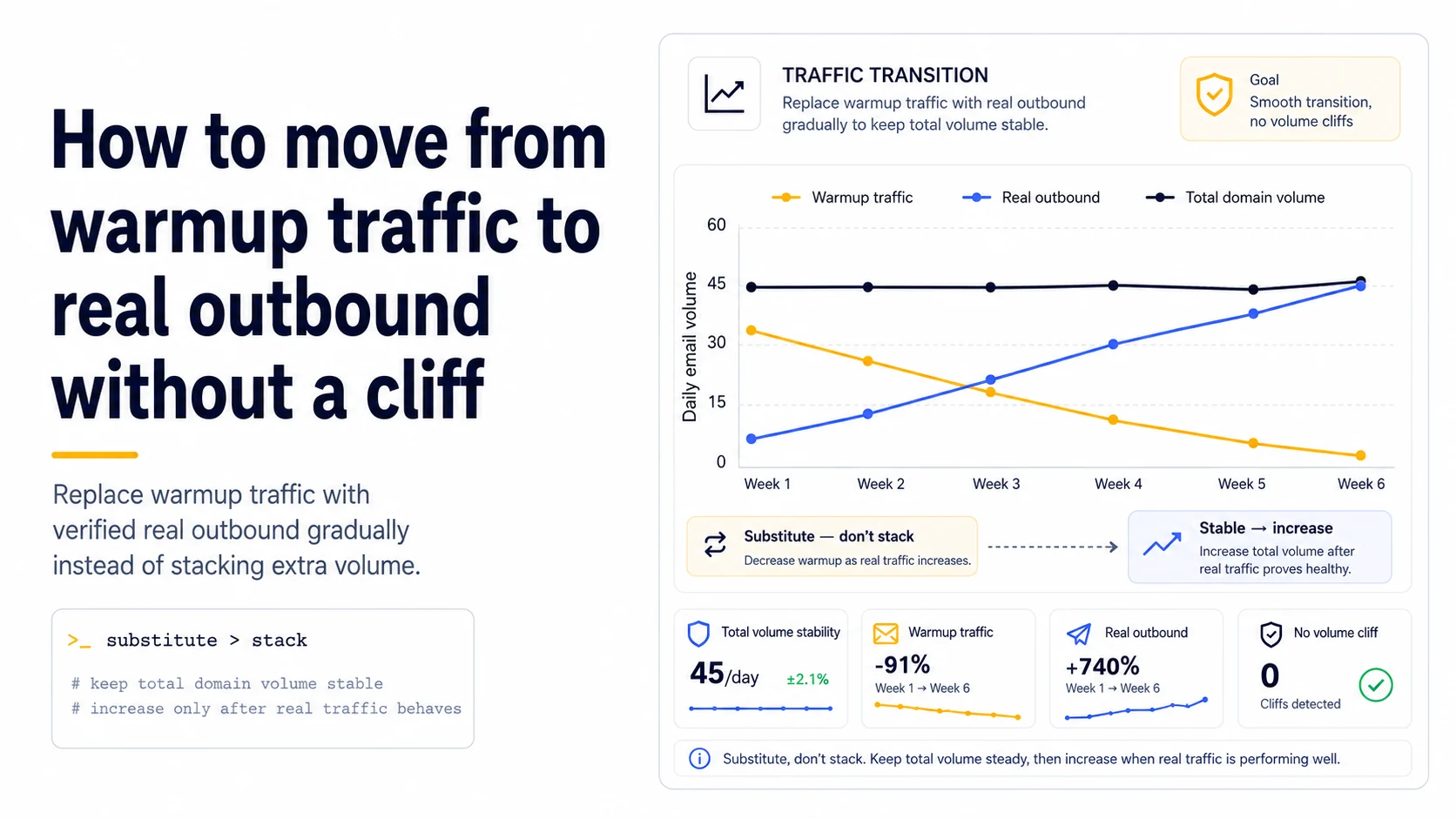
Transition by substitution, not addition
The cleanest move from warmup to real outbound is to replace low-risk traffic with real prospect traffic gradually while keeping total mailbox behavior predictable. If a mailbox is handling 24 messages per day during a warmup phase, adding 40 prospect messages on top creates a 64-message day even though the campaign itself feels small. Instead, introduce a smaller verified prospect tranche inside the existing envelope. This keeps the visible change bounded and lets real replies, hard bounces and suppressions begin shaping the operating history without an overnight cliff.
Verify the first prospect tranche more strictly than the rest
The first real batch is a diagnostic asset, so do not waste it on uncertain data. Normalize addresses, remove duplicates, apply the global hard-bounce suppression list, and re-check old records if the list has been sitting for weeks or months. Catch-all addresses and role accounts should be tagged rather than treated as the same confidence level as a named verified mailbox. A ten-contact tranche that is well understood can tell you more about the transition than a hundred-contact import whose provenance is unclear.
Keep campaign state capable of stopping itself
Real outbound introduces something warmup traffic often does not test well: a person may reply before the next planned touch. The queue should re-check recipient state immediately before every send. If a reply, hard bounce or manual suppression occurred after the sequence was scheduled, the follow-up should be canceled. Do not rely only on pre-created jobs. The transition period is the right time to prove idempotent reply handling and shared suppression, because mistakes are still visible at small scale.
Use total domain volume as the upper-level guardrail
If several mailboxes transition at the same time, per-mailbox plans can hide an aggregate jump. Three accounts each moving from 15 warmup messages to 25 prospect messages can change domain-level behavior sharply even though every account remains below an informal limit. Track both scopes. Stagger transitions if necessary so the operator can tell whether a problem belongs to one mailbox, one list, or the whole domain. Adding mailboxes is an operational scaling choice, not a way to make domain-level traffic disappear.
Expect real outbound to produce more informative negatives
Real prospects will generate permanent address failures, negative replies, out-of-office messages and sometimes temporary deferrals that a synthetic warmup stream may not expose. These are not reasons to panic; they are reasons to improve state. A hard bounce should suppress the address globally. A negative human reply should stop the sequence. An automatic absence response should pause immediate follow-up without becoming a positive sales reply. The quality of the transition depends on what the system learns from each event, not on keeping every metric artificially green.
Increase only after the real traffic itself is stable
Do not let a warmup tool's successful history justify a larger prospect batch. The new baseline must come from real outbound. Run a few comparable tranches, inspect authentication and failures, confirm reply-state logic, and only then expand. If the first real tranche behaves differently from warmup traffic, hold the increase and investigate. The important signal is not whether the mailbox passed a warmup score; it is whether the production workflow can send relevant mail, process recipient feedback, and remain predictable.
Know when to retire the warmup phase
Warmup should not become permanent background traffic simply because removing it feels risky. Once the mailbox has a repeatable real-outbound pattern at the intended working range, reduce or remove artificial traffic in steps while watching total volume. The mailbox should eventually be judged on the real system it needs to operate: authenticated messages, verified recipients, controlled cadence, correct reply handling and clean suppression. If the setup only looks healthy while synthetic messages continue indefinitely, the production baseline has never actually been established.
Model the transition as a fixed traffic envelope
Assume a mailbox has been stable around 24 messages per working day. A poor transition is to keep those 24 background messages and add 20 prospect messages, creating a 44-message day with a completely different recipient mix. A controlled transition keeps the envelope near 24: perhaps 16 low-risk messages and 8 verified prospects, then 10 and 14, then mostly real prospects if the real traffic behaves normally. The exact numbers are illustrative, not provider limits. The useful property is that total traffic does not jump while the composition changes. This makes any new bounce or deferral easier to attribute to the prospect data or content rather than to a simultaneous volume cliff.
Retire warmup when production evidence is sufficient
Warmup should not become a permanent layer that obscures the actual capacity of the mailbox. Once real prospect traffic has produced several comparable batches with clean authentication, controlled permanent failures, stable temporary-deferral behavior and correctly handled replies, begin evaluating the mailbox on production traffic alone. Keep a small test capability for diagnostics, but do not maintain artificial activity simply to preserve a number on a warmup dashboard. The receiver ultimately evaluates the traffic that is actually being sent. A solo operator gains more from accurate production logs than from a background stream that makes total volume harder to understand. The end state is a mailbox whose cap and pacing are based on recent real outcomes, with a documented lower level to return to if health changes.
Keep reply handling live during the transition
The first real prospect batches are also the first time the sequence state machine is exposed to meaningful replies, out-of-office messages and stop requests. Make sure the reply detector, global suppression and follow-up cancellation paths are active before increasing production traffic. A domain can look technically healthy while the campaign system keeps sending after a recipient has replied, creating preventable complaints and duplicate contact. Treat every early reply as a test case: did the message map to the correct lead, did pending jobs disappear, did the inbox retain the intended unread state, and did the contact become ineligible across other mailboxes? A clean transition is not only about send volume; it is about proving that recipient state can stop future mail quickly.
Field checklist
- Replace warmup traffic with real prospects gradually instead of stacking both volumes.
- Use a highly verified first prospect tranche so early failures are interpretable.
- Re-check recipient state immediately before every follow-up send.
- Track aggregate domain volume when multiple mailboxes transition together.
- Classify real negative events into suppression, reply, out-of-office, and transient-failure state.
- Retire artificial warmup once real outbound is repeatable at the intended working range.
Primary sources
Standards and provider policies can change. These links are the reference points used for this field note.
- Email sender guidelinesGoogle Gmail Help — Authentication, TLS, DNS, spam-rate and bulk-sender requirements.
- Email sender guidelines FAQGoogle Gmail Help — Bulk-sender classification, enforcement and DMARC alignment details.
- Sender Requirements & RecommendationsYahoo Sender Hub — Yahoo authentication, complaint-rate, DNS, unsubscribe and flow-control requirements and recommendations.